Rising agricultural input costs put immense pressure on farm budgets today. Global supply chain shifts make chemical inputs increasingly expensive. An inefficient fertilizer spreader does not just waste valuable time in the field. It actively burns through expensive chemical budgets. Poor distribution compromises crop yields through highly inconsistent application rates. Selecting new equipment requires more than scanning price tags. You must view this selection process as a vital strategic decision. Farm managers must balance payload capacity, spread accuracy, and robust corrosion resistance. To maximize your return on investment, evaluate spreaders thoroughly. Look closely at tractor compatibility, material durability, and calibration precision. Relying solely on the lowest upfront cost often guarantees poor performance later. We will explore how to identify the exact equipment profile your farm needs. You will learn how to align machinery specifications directly against your operational goals. Careful planning now prevents massive chemical losses tomorrow.
Key Takeaways
- Matching hopper capacity to your specific field sizes and tractor payload limits reduces compaction and refill downtime.
- Investing in a stainless steel fertilizer spreader dramatically lowers Total Cost of Ownership (TCO) by resisting highly corrosive modern fertilizers.
- Consistent spread patterns and easy calibration are non-negotiable for minimizing overlap, reducing waste, and ensuring compliance with environmental runoff standards.
Defining the Business Case: The ROI of Upgrading Your Agricultural Fertilizer Spreader
Legacy equipment often bleeds money through hidden inefficiencies. "Striping" occurs when distribution patterns fail. This phenomenon leaves distinct bands of over-fertilized and under-fertilized crops. It damages overall field consistency. Overlapping passes double your chemical waste. They also force tractors to burn excessive fuel unnecessarily. An upgraded agricultural fertilizer spreader solves these critical issues definitively.
How do you define a successful equipment upgrade? First, you need precise application rates consistently across every single acre. Second, you must achieve a significant reduction in total pass times. Fewer passes mean less soil compaction. Finally, the machine must integrate seamlessly into your existing tractor setup. This includes matching PTO shafts and having adequate hydraulic remote connections.
Operation scale dictates your primary needs. Small to midsize operations thrive on agility. These farms need maneuverable units for tight headland turns. They frequently navigate smaller, irregularly shaped fields. Large-scale commercial farming demands maximum hopper volume. They also rely heavily on Variable Rate Technology. VRT compatibility allows large farms to map massive acreages efficiently. Ignoring scale differences leads to severe misallocation of capital. Buying too small causes endless refill trips. Buying too large damages soil structure permanently. You must right-size your implement choice.
Solution Categories: Which Spreader Architecture Fits Your Operation?
Pull-type spreaders tow directly behind your tractor. Broad-acre farms prefer them to maximize capacity per trip. They drastically reduce refill stops. You cover much more ground per hour. However, implementation requires careful planning. You must calculate soil compaction risks carefully. Heavy tow-behind units press deeply into damp soil. They also require robust tractor drawbar ratings. You cannot simply hitch a massive hopper to a compact utility tractor. The tongue weight alone can compromise steering control.
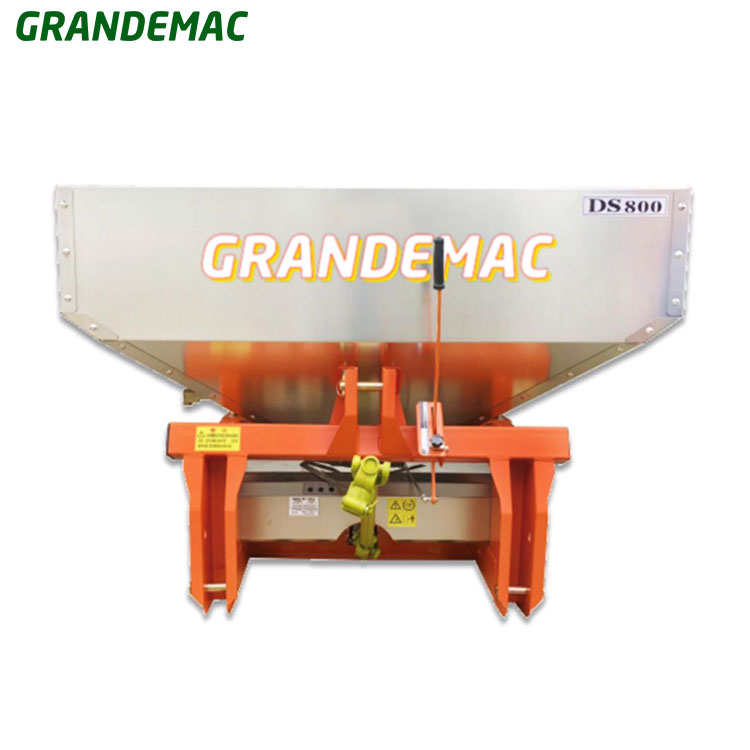
Three-point hitch or tractor-mounted spreaders lift entirely off the ground. Mid-sized fields and row crops benefit most from this design. They offer exceptional maneuverability. You can back into tight corners easily. They also allow for rapid road transport between disparate plots. The implementation reality is stricter here. You are strictly limited by your tractor's rear lift capacity. You must check your tractor's Category II or III hitch ratings. Exceeding this limit causes dangerous steering instability. These mounted units often feature twin-disc broadcasting systems. Twin discs ensure highly accurate distribution.
You must also choose between drop and broadcast distribution. Drop spreaders release granules straight down. They provide maximum precision. They resist wind drift beautifully. Unfortunately, they cover a much narrower swath. Broadcast or spinner spreaders prioritize high efficiency. They cover a massive swath in a single pass. However, their success depends entirely on rigorous calibration. Wind conditions also impact broadcast accuracy heavily. You cannot spray accurately in a gale.
Core Evaluation Dimensions: Specifying Your Ideal Fertilizer Spreader
Calculating optimal hopper size requires balancing two opposing forces. You want to reduce refill trips to save time. Yet, you must manage soil compaction limits rigorously. Local soil types determine how much weight you can safely carry. Heavy clay soils compact easily under massive payloads. Sandy soils forgive heavier equipment.
| Farm Scale | Typical Hopper Size | Compaction Risk | Ideal Soil Condition |
| Small / Agility-Focused | 400L - 800L | Low | Wet or easily compacted clay |
| Midsize / Row Crop | 800L - 1500L | Moderate | Mixed loams |
| Broad-Acre / Commercial | 1500L - 3000L+ | High | Dry, firm sandy soils |
Next, evaluate spread width and uniformity. Spinner design plays a major role here. Single disc models suit smaller operations. Twin disc models provide superior predictability across the spread pattern. Look for adjustable vanes on the discs. Changing vane angles alters the throw trajectory. Wind conditions alter your effective working width significantly. Fertilizer granular density also changes how far the material flies. Heavy granules travel further than light powders. You must match disc speed to the specific material density.
Evaluate the internal agitator design closely. Slow-rotating agitators prevent granule crushing. Fast agitators pulverize expensive prills into useless dust.
Finally, consider build material. Modern fertilizers contain highly aggressive chemicals. Urea and potash eat through standard metals quickly. Upgrading to a stainless steel fertilizer spreader stands as a baseline requirement for commercial longevity. It effectively mitigates rust. This material choice heavily reduces seasonal maintenance costs. Painted steel or poly-hoppers often degrade faster under intense agricultural use. Long-term durability protects your initial investment. Paint chips eventually, but steel alloy resists corrosion intrinsically.
Precision, Calibration, and Technology Integration
If a machine is difficult to calibrate, operators will simply skip the process. This is a brutal operational reality. Skipping calibration guarantees application errors. Emphasize the need for accessible, tool-free gate adjustments. Operators should not need wrenches in a muddy field. Clear calibration charts must ship alongside the unit. They guide operators through quick setup procedures.
For advanced operations, integrate the following technological features:
- Variable Rate Technology (VRT): ISOBUS compatibility allows rapid communication between tractor and implement. It gives you the ability to adjust application rates on the fly. You base these changes on real-time soil mapping. This places nutrients only where crops actually need them.
- Section Control: High-end units offer edge-spreading capabilities. Deflector plates drop down electronically. This prevents expensive fertilizer waste in ditches. It keeps chemicals off neighboring properties. This serves as a crucial environmental compliance factor in highly regulated watersheds.
- Dynamic Weighing: Load cells monitor exact output continuously. They feed data back into your monitor to auto-correct flow rates. You never guess how much product remains in the hopper. It eliminates uneven field coverage caused by changing ground speeds.
A common mistake involves ignoring fertilizer bulk density variations. Two different batches of urea can flow at completely different rates. Humidity alters granular flow characteristics significantly. Always recalibrate when opening a new pallet of product. Relying on last week's settings guarantees poor distribution today.
Best practice dictates running a physical catch-test before applying new blends. Collect the output over a set distance. Weigh the captured material carefully. Compare this against your target rate. Adjust the metering gate accordingly. Never trust factory settings blindly.
Implementation Risks: Maintenance and Long-Term Reliability
Corrosion destroys agricultural investments rapidly. Proper wash-down procedures prevent this decay. Look for design features favoring rapid, thorough cleaning. Open architectures let water flush away debris easily. Avoid machines featuring blind corners. Corrosive material gathers silently in these hidden pockets. It slowly eats through structural welds over the winter. A smooth hopper interior guarantees all material slides out cleanly.
Drivetrain durability dictates field readiness. Evaluate the reliability of PTO drives versus hydraulic drives. Hydraulic systems offer smoother engagement. They eliminate snapping shear pins during sudden starts. PTO systems deliver raw mechanical power reliably. Regardless of your choice, demand sealed gearboxes. They keep dust and aggressive chemicals away from internal gears. You also need easily accessible grease points. If maintenance is hard to reach, operators will ignore it. Common mistakes include ignoring PTO shaft lubrication.
Winterization processes separate long-lasting machinery from scrap metal. Before storing your unit, power wash every crevice thoroughly. Coat exposed metal surfaces in a light protective oil. Store the machine under a roof to prevent UV degradation of any poly components. Protect the hydraulic hoses from freezing temperatures. Neglecting these basic storage procedures destroys equipment faster than actual field use.
Never overlook parts availability and your local dealer network. A breakdown during the narrow fertilization window spells disaster. Missing a weather window impacts your entire harvest. Factor local dealer support heavily into your final purchasing decision. Fast replacement parts availability keeps you running when time matters most. Stocking spare spinner vanes and agitator pins on the farm prevents unnecessary downtime.
Next Steps: Structuring Your Shortlist
You need a structured approach to narrow down your options. Use this decision framework:
- Define your maximum tractor lift capacity and tow ratings precisely. Do not guess these numbers. Consult your operator manual. Check your hydraulic flow rates as well.
- Audit the corrosiveness of your preferred fertilizers. Match your hopper material accordingly. Avoid painted mild steel if you apply heavy sulfur or potash blends frequently.
- Determine the required spread width to maximize operational efficiency. Align this with your sprayer tramlines. You want implements sharing the same wheel tracks. This minimizes overall field compaction.
- Review your local dealer proximity. Ensure they stock crucial replacement parts locally during the busy spring season.
Always request a physical demonstration. Ask the manufacturer to provide specific spread-pattern data before finalizing the purchase. Testing the machinery proves its real-world capabilities. A standard fertilizer spreader might look great on paper. Field performance reveals its true value. Pay close attention to how easily the machine hooks up to your tractor. Note how intuitively the calibration interface operates.
Conclusion
Farm managers face immense pressure to optimize every input. Securing the ideal equipment protects your budget and boosts yield potential. By carefully evaluating capacity, material resilience, and precision technology, you guarantee a more productive growing season.
- Audit your tractor fleet capabilities before engaging any equipment dealers.
- Prioritize corrosion-resistant materials for all components touching chemical granules.
- Train your operating team on proper calibration protocols prior to the spring season.
- Establish a strict post-application wash-down routine to extend equipment lifespan.
FAQ
Q: Is a stainless steel fertilizer spreader worth the premium price?
A: Yes. High-quality steel resists the aggressive nature of urea and potash. This material choice multiplies the expected lifespan of your equipment. It slashes seasonal maintenance labor drastically. You spend less time grinding away rust or replacing degraded components, ensuring the machine remains field-ready for years.
Q: How do I calculate the right hopper capacity for my tractor?
A: Check your tractor manufacturer's manual for the maximum rear lift or drawbar capacity. Multiply the volume of the hopper by the bulk density of your heaviest fertilizer blend. Ensure this total loaded weight remains well under your tractor's specified safe operating limits.
Q: How often should an agricultural fertilizer spreader be calibrated?
A: You must calibrate the machine at the start of every season. Additionally, perform a full calibration whenever you switch fertilizer blends. Changing granular sizes alters flow dynamics completely. Frequent checks guarantee precise application rates and prevent expensive chemical waste across your acreage.


