Power selection is one of the most common questions we hear from growers and small farm owners. When investing in a 4WD Farm Orchard Tractor, buyers often wonder whether 25 horsepower is sufficient for daily orchard tasks or whether they should consider a larger engine. The answer depends not only on horsepower numbers, but also on terrain, soil conditions, row spacing, attachments, and long-term operational goals. At Jiangsu Grande Machinery Manufacturing Co., Ltd., we design orchard tractors specifically for real working environments, and we believe that understanding application requirements is more important than simply choosing higher horsepower.
A 25 horsepower tractor can be more than enough in the right conditions. However, selecting the right configuration ensures productivity, fuel efficiency, and long-term reliability. In this article, we analyze practical field scenarios to help determine whether 25 HP is suitable for your orchard or small farm.
Understanding What 25 Horsepower Really Means
Horsepower represents engine output capacity. A 25 HP tractor provides moderate power suitable for light to medium-duty agricultural work. In orchard operations, horsepower is only one factor. Torque output, transmission design, and four-wheel drive capability significantly influence performance.
A 25 HP 4WD Farm Orchard Tractor typically delivers:
Stable PTO power for light implements
Efficient fuel consumption
Strong traction when paired with 4WD
Compact size for narrow rows
For orchards with tight spacing between trees, compact dimensions often matter more than high horsepower. Excessively large tractors can damage crops and reduce maneuverability.
When 25 HP Is Sufficient for Orchard Work
A 25 horsepower tractor performs effectively in the following scenarios:
1. Light Soil Cultivation
Rotary tillers, small plows, and inter-row cultivators operate efficiently within this power range.
2. Spraying and Fertilizer Application
Most orchard sprayers do not require high PTO output. A 25 HP engine provides stable power for pump-driven spraying systems.
3. Mowing and Weed Control
Flail mowers and small shredders designed for orchard maintenance are compatible with 25 HP tractors.
4. Small Trailer Hauling
Transporting harvested fruit bins or light equipment within the orchard is manageable.
Table 1: Typical Tasks Suitable for a 25 HP 4WD Farm Orchard Tractor
Task Type | Power Demand | 25 HP Suitability | Notes |
Spraying | Low | Excellent | Stable PTO output |
Light Tilling | Moderate | Good | Soil type matters |
Mowing | Moderate | Good | Match implement width |
Heavy Plowing | High | Limited | May require higher HP |
Large Trailer Hauling | High | Conditional | Depends on load weight |
The Importance of 4WD in a 25 HP Tractor
Horsepower alone does not determine real field capability. In orchard environments, traction often matters more than raw engine output. Four-wheel drive significantly enhances stability and pulling efficiency, especially in orchards with challenging ground conditions such as:
Wet irrigation soil
Sloped terrain
Loose sandy ground
Uneven surfaces
In these environments, a 2WD tractor may struggle with wheel slip, reduced traction, and inconsistent power delivery. When rear wheels lose grip, engine power is wasted in spinning rather than forward movement. A 4WD Farm Orchard Tractor distributes torque across all four wheels, allowing power to be applied evenly to the ground. This improves grip, reduces slippage, and enhances overall working efficiency.
For example, during spraying operations on slight slopes, a 25 HP 4WD tractor can maintain stable forward movement without hesitation. Similarly, in sandy or soft soil, front-wheel engagement prevents sinking and maintains momentum. In practical terms, this means a 25 HP 4WD tractor often performs comparably to higher horsepower 2WD models in difficult terrain conditions. Instead of increasing engine size, optimizing traction can deliver better real-world results.
Improved traction also reduces fuel waste caused by spinning wheels. When wheels maintain steady grip, less throttle is required to maintain movement. This not only improves fuel efficiency but also decreases mechanical stress on the drivetrain and transmission system.
Terrain and Soil Conditions Matter
Choosing whether 25 horsepower is enough depends heavily on terrain and soil characteristics. If your orchard is located on flat, well-drained land with moderate soil resistance, 25 horsepower is generally sufficient for daily orchard tasks such as mowing, spraying, and light tilling.
However, if your operation includes:
You may consider 35–50 HP for additional power margin. Heavy clay soil increases rolling resistance and requires more torque for tillage. Steep slopes demand consistent pulling power to maintain safe climbing performance.
That said, many orchard owners overestimate their horsepower needs. Larger engines consume more fuel, increase initial investment cost, and may reduce maneuverability in narrow rows. For small to medium orchards, a properly configured 25 HP 4WD Farm Orchard Tractor often delivers the right balance between efficiency, traction, and operating cost.
Implement Matching Is Critical
A tractor’s real-world effectiveness depends on proper implement matching.
For example:
Oversized attachments strain the engine and transmission, leading to premature wear. Correct implement width and weight ensure smooth operation and long-term durability.
Table 2: Recommended Implement Pairing for 25 HP Orchard Tractor
Implement | Recommended Width | Suitable for 25 HP | Application |
Rotary Tiller | 1.0–1.2 m | Yes | Soil preparation |
Flail Mower | 1.0–1.3 m | Yes | Grass control |
Orchard Sprayer | 200–400 L | Yes | Pest management |
Disc Plow | Small size | Conditional | Light soil only |
Fuel Efficiency and Operating Cost
One major advantage of 25 horsepower tractors is fuel economy. Smaller engines consume significantly less diesel compared to mid-size models.
For small orchard operators, fuel savings accumulate over years of operation. Lower fuel consumption also reduces environmental impact, aligning with sustainable agricultural practices.
Compact tractors also require less storage space and are easier to transport between fields.
Maneuverability in Orchard Rows
Orchard work requires tight turning between tree rows. A 25 HP 4WD Farm Orchard Tractor is typically compact, with narrow wheelbase and short turning radius.
Benefits include:
Large tractors may offer more power, but they sacrifice agility.
Maintenance and Longevity Considerations
Smaller engines typically experience less mechanical stress when properly matched with their intended workload. A 25 HP engine that operates within recommended load levels avoids constant over-throttling, excessive heat buildup, and premature internal wear. With structured servicing, a well-built 4WD Farm Orchard Tractor can deliver consistent performance for many years, even under seasonal peak demands.
Key longevity practices include:
Regular oil changes to maintain proper lubrication and prevent internal friction
Monitoring cooling systems to avoid overheating during long orchard working hours
Inspecting drivetrain components such as the front axle and differential to ensure smooth 4WD engagement
Maintaining correct tire pressure to reduce strain on transmission and suspension systems
When paired with 4WD traction stability, torque is distributed more evenly across all wheels. This balanced power transfer minimizes localized stress on rear axles and reduces long-term component wear, ultimately extending the tractor’s service life.
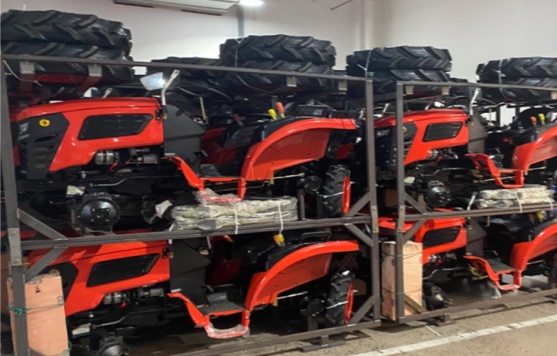
Comparing 25 HP with Higher Horsepower Options
Many buyers assume “bigger is better,” but that is not always true in orchard environments.
Comparison Overview
Feature | 25 HP 4WD Tractor | 40–50 HP Tractor |
Fuel Consumption | Low | Moderate–High |
Maneuverability | Excellent | Moderate |
Initial Cost | Lower | Higher |
Suitable Land Size | Small–Medium | Medium–Large |
Attachment Capacity | Light–Medium | Medium–Heavy |
The right choice depends on real operational needs rather than perception.
Practical Recommendation Framework
Ask yourself:
How many hectares do I manage?
What attachments will I use most often?
Is my terrain flat or sloped?
Do I prioritize fuel efficiency and maneuverability?
If your orchard is under 20 hectares and primarily involves spraying, mowing, and light tilling, a 25 HP 4WD Farm Orchard Tractor is typically sufficient.
How We Approach Orchard Tractor Design
At Jiangsu Grande Machinery Manufacturing Co., Ltd., we focus on application-driven engineering. Our orchard tractors are designed with:
Reinforced front axles for 4WD stability
Efficient diesel engines optimized for fuel economy
Compact chassis for orchard maneuverability
Durable hydraulic systems for implement compatibility
Rather than simply increasing horsepower, we refine drivetrain balance and torque efficiency to ensure stable performance in orchard environments.
Conclusion
Selecting tractor power should be a practical decision based on land size, terrain, and implement requirements. For many orchard operations, a 4WD orchard tractor with 25 horsepower offers the ideal balance between efficiency, maneuverability, and cost control. With proper implement matching and regular maintenance, it can handle daily orchard tasks reliably for years.
If you would like guidance on selecting the right tractor configuration for your farm, we invite you to contact Jiangsu Grande Machinery Manufacturing Co., Ltd. Our team can help evaluate your orchard conditions and recommend a suitable solution tailored to your operational needs.
FAQ
1. Is a 25 horsepower tractor enough for orchard spraying?
Yes. A 25 HP 4WD Farm Orchard Tractor provides sufficient PTO power for most orchard sprayers.
2. Does 4WD make a difference on a 25 HP tractor?
Absolutely. Four-wheel drive improves traction on slopes and wet soil, increasing efficiency and stability.
3. Can a 25 HP tractor handle rotary tilling?
Yes, if matched with appropriately sized implements, typically 1.0–1.2 meters wide.
4. When should I consider upgrading from 25 HP?
If your farm exceeds medium scale or requires heavy plowing and large transport loads, higher horsepower may be more suitable.


