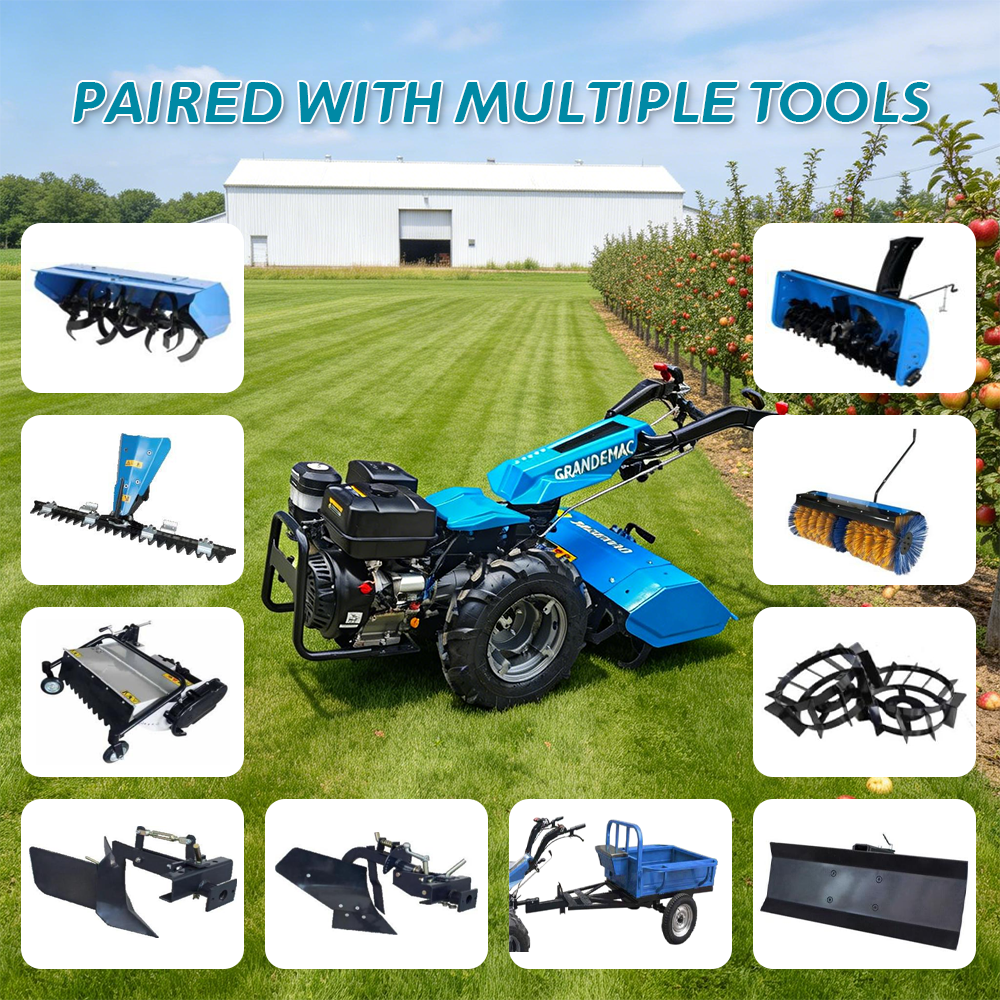
Orchard management presents severe physical and mechanical constraints. Standard agricultural equipment constantly struggles to maneuver between established tree rows. Low-hanging canopies and tight access gates make navigation incredibly difficult. Preparing soil for cover crops, managing weeds, or replanting requires precision. Operators face the challenge of doing this without causing severe fatigue. They must also avoid damaging shallow root systems or degrading soil structure through over-pulverization. Standard front-tine and rear-tine tillers often fall short in these demanding environments.
A dedicated 2 Wheel Tractor with Rotary Tiller offers a highly effective alternative. It separates wheel drive from the implement, providing a scalable and ergonomic solution. This system delivers exceptional maneuverability compared to a traditional ride-on machine. It allows operators to work efficiently in tight spaces without compromising soil health. By understanding the mechanical advantages of this equipment, orchard managers can significantly improve their soil preparation workflows.
Ergonomic Advantage: Independent wheel drive and Power Take-Off (PTO) on two-wheel tractors drastically reduce operator fatigue, steering effort, and vibration compared to standard dedicated rototillers.
Soil Structure Preservation: Adjustable depth control, variable PTO speeds, and targeted passes prevent the over-pulverization of topsoil, mitigating the risk of hardpan formation.
Operational Versatility: Unlike single-purpose tillers, the base tractor unit supports multiple implements, offering a higher ROI for year-round orchard maintenance.
Space Optimization: Walk-behind maneuverability allows for aggressive soil preparation in tight plots, terraced rows, and micro-zones where a standard four-wheel orchard tractor cannot physically operate.
The Unique Constraints of Orchard Soil Preparation
Defining Success Criteria
Successful orchard soil preparation requires meeting specific baseline criteria. Efficient weed incorporation is essential for reducing competition for water and nutrients. Creating a proper seedbed for cover crops ensures healthy germination and growth. Most importantly, operators must achieve these goals with minimal root disturbance. Protecting the established trees is always the primary objective during any cultivation task. You need a machine that cuts cleanly through surface vegetation without digging so deep that it tears into the feeder roots. We look for equipment that leaves a level, uniform finish behind the pass. This prevents water pooling and makes future mowing operations much smoother. Achieving this balance requires precise control over both ground speed and implement depth.
Navigating Tight Row Spacing and Canopy Limits
High-density orchards impose strict spatial limitations on machinery. Traditional four-wheel compact machines often require excessive vertical and horizontal clearance. Operating a standard Orchard Tractor in these conditions risks damaging low-hanging fruit and branches. Irrigation lines are also vulnerable to heavy tires and wide implements. Walk-behind equipment eliminates these risks by fitting easily within narrow rows and operating safely under low canopies. When you drive a large machine down a tight row, you constantly watch your clearance on both sides. A walk-behind unit lets you walk offset from the machine. You can guide the tiller right up to the drip line without putting your body or the engine into the branches. This level of control prevents costly damage to your crop and your irrigation infrastructure.
Inaccessible Micro-Plots and Terraced Zones
Many orchards feature steep slopes, terraced contours, or plots blocked by narrow gates. These areas become restricted zones for standard ride-on machinery. Manual hand-tool labor is too slow and physically demanding for these sections. The walk-behind tractor serves as the ultimate solution for bridging this gap. It provides heavy-duty mechanical power in areas where only hand tools could previously reach. If you manage hillside plantings, you know the danger of operating high-center-of-gravity equipment on a slope. Walk-behind units keep the weight low to the ground. You can safely traverse terraced rows and work soil that would otherwise remain unmanaged. Narrow access gates no longer dictate your equipment choices when you use a machine designed to fit through standard pedestrian openings.
Protecting Shallow Feeder Roots from Compaction
Soil compaction over critical root zones severely impacts tree health. Heavy ride-on machinery distributes massive weight across its axles, driving compaction deep into the soil tier. Walk-behind equipment features a vastly different weight distribution. The lighter footprint minimizes ground pressure significantly. This protects the shallow feeder roots that are vital for nutrient uptake and overall orchard vitality. When you compact the soil, you squeeze out the pore spaces that hold oxygen and water. Trees suffocate in compacted ground. By switching to lighter, walk-behind equipment, you preserve the soil structure. The roots can breathe, water infiltrates properly, and the trees remain vigorous and productive year after year.
Dedicated Rototillers vs. 2 Wheel Tractors: A Structural Comparison
Power Take-Off (PTO) Efficiency and Ground Drive Separation
The mechanical differences between dedicated tillers and two-wheel tractors are profound. Dedicated tillers often rely on the tines for forward propulsion. This design causes the machine to buck and jump aggressively over hard ground. Two-wheel tractors separate the wheel drive from the PTO-driven implement. The engine powers the wheels independently of the tines. This separation allows for consistent tilling depth regardless of soil hardness or terrain challenges. You select your ground speed using the transmission gears. The PTO spins the implement at a constant, optimal speed. If you hit a hard patch of clay, the driven wheels keep the machine moving forward at a steady pace. The tines do not dictate your travel speed, giving you total control over the soil finish.
Operator Ergonomics: Managing Vibration and Steering Fatigue
Operating machinery in hard, sun-baked orchard soils takes a massive physical toll. Standard dedicated rototillers require the operator to physically sink and steer the machine. This exhausting process transmits intense vibration directly into the operator's arms and back. A heavy two-wheel tractor applies balanced, self-propelled downward force. Anti-vibration mounts and reversible, height-adjustable handlebars further reduce musculoskeletal fatigue. The machine does the heavy lifting, allowing the operator to simply guide it. You can adjust the handlebars to match your height perfectly. You can even swing the handlebars to the side. This allows you to walk in the un-tilled path, keeping your boots out of the freshly prepared seedbed. This offset walking position also keeps you clear of low-hanging branches while the machine works under the canopy.
How a 2 Wheel Tractor with Rotary Tiller Optimizes the Soil Bed
Seedbed Creation: Pulverization vs. Traditional Soil Inversion
Traditional plows invert deep soil layers and disrupt critical microbial horizons. This aggressive action is rarely suitable for established orchards. A Rotary Cultivator takes a different approach. It pulverizes the topsoil to create a fine, loose bed. This texture is ideal for seed germination when planting cover crops. It mixes organic matter into the top layer without destroying the deeper soil structure. You want to create a shallow zone of loose soil where seeds can establish quick root contact. Deep inversion brings subsoil to the surface and buries your fertile topsoil. The rotary action blends the existing vegetation, manure, and topsoil into a nutrient-rich matrix right where the new seeds need it most.
Precision Depth Control to Prevent Over-Pulverization
Destroying soil aggregates carries significant agronomic risks. Turning soil into fine dust causes it to crust over after rain, severely limiting water infiltration. Adjustable skid shoes and trailing boards on high-quality attachments prevent this issue. Operators can target only the top two to three inches of soil. This precision depth control protects the soil structure while still achieving the necessary surface preparation. You set the center depth control lever to your desired penetration level. The machine maintains this depth consistently across the entire row. By keeping the tilling action shallow, you avoid churning up dormant weed seeds from deeper soil layers. You also preserve the natural capillary action that draws moisture up from the subsoil during dry periods.
Single-Pass Efficiency: Turning and Breaking Soil Simultaneously
Tiller blades invert the soil layer while simultaneously breaking clods. This mechanical action reduces the need for multiple passes across the same ground. It eliminates multi-step tillage processes, saving valuable time and fuel. Using a disc harrow might achieve similar results in open fields. However, space and speed constraints make discs highly impractical in small, densely planted orchards. You want to get in, prep the soil, and get out. Running multiple implements over the same ground wastes labor hours and increases the risk of compaction. A properly configured rotary attachment chops the weeds, fractures the soil, and levels the bed in one smooth operation. You can immediately follow up with a seeder and finish the job.
Managing Cover Crops and Orchard Floor Residue
Orchard floors often contain thick green manure or pruning residue. The equipment must chop and incorporate this material effectively. A robust tiller attachment blends this organic matter directly into the topsoil. This process accelerates decomposition and returns nutrients to the earth. It keeps the orchard floor clean and reduces habitats for overwintering pests. When you mow a tall cover crop, the residue sits on the surface and breaks down slowly. Tilling it into the top two inches of soil puts the organic matter in direct contact with soil microbes. The breakdown process speeds up dramatically. This rapid decomposition releases nitrogen and other essential nutrients back into the soil profile just as your trees enter their active growth phase.
Operational Pro-Tips: Optimizing Settings to Save Fuel and Time
Proper setup maximizes field efficiency and prevents wasting daylight or diesel. Match your ground speed to the PTO RPM for the best soil finish. Adjust the throttle to maintain steady power without over-revving the engine. Plan your tilling path carefully to minimize tight turns at row ends. Consistent, straight passes reduce overlap and ensure uniform soil preparation across the entire plot. If the soil is particularly hard, drop down a gear. Let the machine move slower while keeping the PTO speed high. This gives the tines more time to fracture the hard ground. If the soil is already loose, shift up a gear. You will cover more ground per hour and prevent the tines from over-pulverizing the dirt into a fine powder.
Evaluating the Rotary Cultivator Attachment: Key Specifications
Tine Design and Rotation Speed (RPM)
Different tine designs serve distinct agricultural purposes. Bolo tines are standard for general tilling, while slasher tines handle heavy vegetation. Pick tines excel in breaking up extremely hard, rocky soils. Matching the PTO RPM to your ground speed dictates the coarseness of the soil finish. Faster RPMs with slower ground speeds create a finer seedbed. Slower RPMs leave a coarser finish, which helps prevent soil crusting in heavy rains. You must inspect your tines regularly. Worn tines lose their cutting edge and begin to smash the soil rather than slicing it. This increases the load on the engine and results in a clumpy, uneven seedbed. Replace the tines as a complete set to maintain balance on the rotor shaft.
Width Configurations for Specific Orchard Layouts
Selecting the correct implement width depends entirely on your tree spacing. The tiller must cover the wheel track to avoid leaving compacted tire ruts behind the machine. Wider passes increase efficiency but demand more engine power and reduce maneuverability. Narrower passes allow for precise navigation around trunks and irrigation heads. Evaluate your specific row dimensions before finalizing your equipment width. Measure the narrowest pinch point in your orchard. This might be a gate, a mature tree trunk, or a permanent irrigation riser. Your implement width must clear this pinch point easily. It is better to make two passes with a narrower, highly maneuverable machine than to struggle with a wide implement that constantly snags on branches and infrastructure.
Tine Type
Primary Application
Soil Finish Characteristics
Ideal Soil Condition
Bolo Tines
General soil preparation and seedbeds
Medium to fine pulverization
Loam, sandy loam, previously worked soil
Slasher Tines
Incorporating heavy cover crops and weeds
Coarse chopping and mixing
Thick vegetation, green manure incorporation
Pick Tines
Breaking hardpan and rocky terrain
Aggressive fracturing, minimal mixing
Compacted clay, rocky ground, unbroken soil
Implementation Risks and Mitigation Strategies
Avoiding Hardpan Formation in Clay-Heavy Soils
Tilling at the exact same depth repeatedly creates a smeared, impermeable layer called a tillage pan. This hardpan restricts water drainage and root penetration. Mitigate this risk by varying your tilling depth year-over-year. Avoid tilling when soil moisture is too high, as wet clay smears easily. Integrating deep-rooting cover crops also helps naturally fracture any developing compaction layers. You can test soil moisture by squeezing a handful of dirt. If it forms a tight ball that does not crumble when poked, it is too wet to till. Wait a few days for the ground to dry. Tilling wet soil causes severe structural damage that takes years to correct. Plant radishes or deep-rooted legumes to punch through any minor hardpan layers during the off-season.
Maintenance Protocols for the Tractor and Tiller Drive Systems
Consistent maintenance ensures efficiency and operator safety. PTO couplings require regular cleaning and lubrication to prevent binding. Check the gear oil in the tiller transmission before every major seasonal use. Replace worn tines promptly; dull blades force the engine to work harder and result in poor soil mixing. Keeping the drive belts properly tensioned prevents slipping under heavy loads. Clean the machine thoroughly after every use. Dirt and debris trap moisture against the metal components, accelerating rust. Grease all zerk fittings according to the manufacturer's schedule. A well-maintained machine starts easier, runs cooler, and delivers consistent power to the ground. Neglecting basic maintenance leads to premature gearbox failure and costly downtime during your busiest planting windows.
Conclusion
Measure your narrowest orchard rows and gate clearances to determine your maximum allowable equipment width.
Assess your primary soil type to select the appropriate tine design and required engine horsepower.
Schedule a dealer demonstration to test the physical balance of the machine and verify PTO compatibility.
Establish a strict maintenance schedule for checking gear oil and replacing worn tines before the planting season begins.
FAQ
Q: Can a 2 wheel tractor with a rotary tiller break new, uncultivated ground?
A: Yes, it can break new ground, provided the tractor has sufficient horsepower. You must make multiple shallow passes rather than attempting to till deeply on the first run. This approach prevents machine abuse and ensures the tines can effectively fracture the compacted soil without stalling the engine.
Q: How does a rotary cultivator differ from a power harrow for orchard use?
A: A power harrow uses vertical axis mixing, which stirs the soil without inverting it, preserving soil layers. A rotary tiller uses horizontal axis inversion, which aggressively chops and turns the soil over. Tillers are better for incorporating heavy residue, while harrows are gentler on soil structure.
Q: Is a two-wheel tractor harder to operate than a standard rototiller?
A: No, it is actually much easier. Despite being heavier, the independent wheel drive propels the machine forward. You do not have to physically hold the machine back or wrestle it to maintain depth. The tractor does the work, drastically reducing operator fatigue and vibration.
Q: What is the ideal tilling depth for orchard cover crop preparation?
A: The ideal depth is typically shallow, ranging from 2 to 4 inches. This depth is sufficient to incorporate seeds and organic matter while protecting the critical shallow feeder roots of your fruit trees. It also helps preserve the deeper soil microbiome.
Q: Can I use a disc harrow instead of a rotary tiller on a walk-behind tractor?
A: While disc harrows are cheaper, they require significant weight and speed to cut effectively. Walk-behind units often lack the necessary speed and mass for discs to perform well. Active PTO-driven tillers are far more precise and effective for these specific machines.
Q: How do I prevent the rotary tiller from destroying my orchard's soil structure?
A: Always till at proper moisture levels; avoid working wet soil. Do not over-till the same area repeatedly. Utilize the correct PTO speed relative to your ground speed, and adjust the rear trailing flap to control how finely the soil is pulverized.