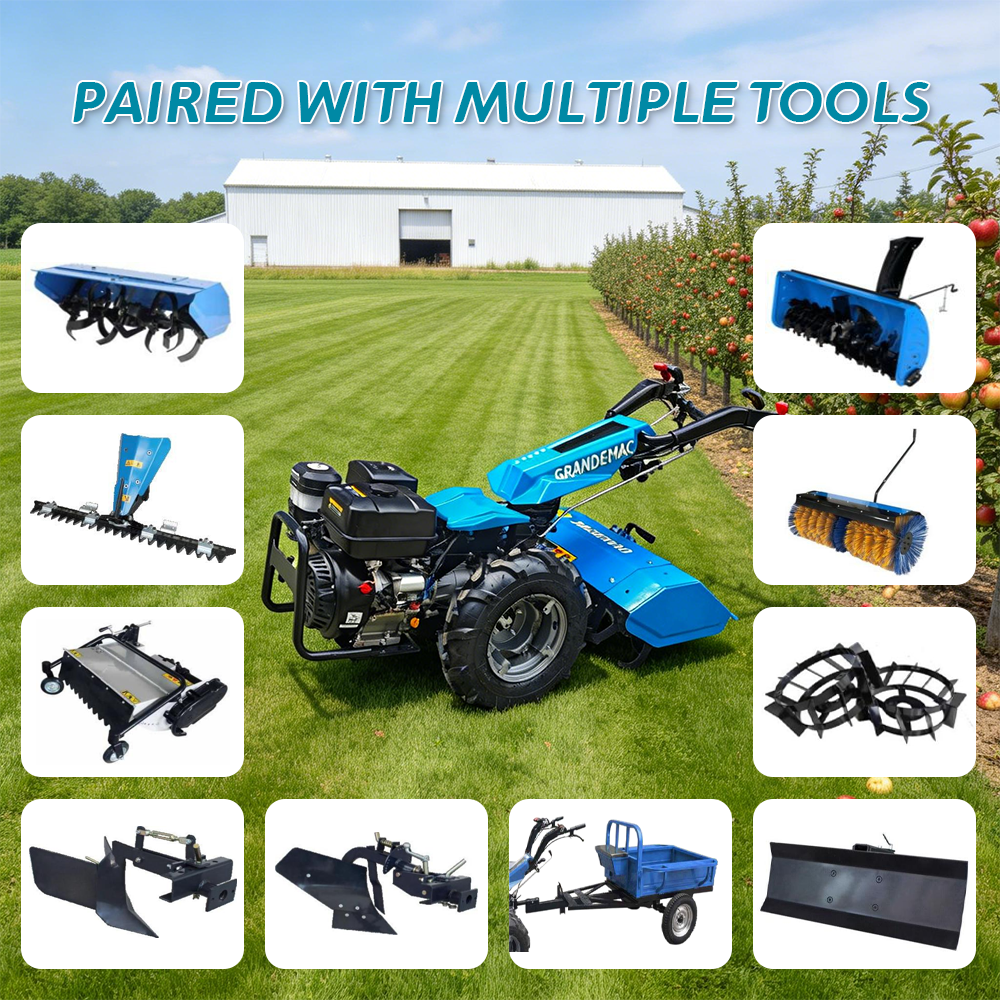
High-density orchards maximize fruit yield per acre. However, they create severe logistical challenges. Standard farming equipment struggles in these tight spaces. Bulky machines compact the soil heavily. They damage shallow root systems. They often injure low-hanging branches during routine passes. You face a constant battle. You must balance efficient land use against equipment accessibility. Transitioning to walk-behind equipment offers a highly practical solution. Adopting a compact unit as your primary power source changes how you maintain tight rows. Evaluating this shift requires a close look at mechanical advantages. You must also consider physical realities and financial implications. In this guide, we break down exactly how this machinery operates in confined agricultural spaces. You will learn about specialized attachments, terrain handling, and equipment selection frameworks. We aim to help you determine if deploying this compact equipment aligns perfectly with your specific vineyard or orchard management needs.
Key Takeaways
An orchard two wheel tractor offers a zero-turn radius and minimal soil footprint, allowing active management in rows as narrow as 24 to 30 inches.
Initial capital expenditure and long-term maintenance costs are significantly lower than specialized narrow four-wheel tractors.
Success depends on matching the power take-off (PTO) capabilities with specific orchard implements like flail mowers and rotary plows.
Adoption requires factoring in operator fatigue and physical handling realities on sloped or uneven orchard terrain.
The Mechanics of Navigating High-Density Orchards
High-density planting limits turning space at row ends. A compact Two Wheel Tractor solves this using differential drives. Individual wheel braking allows the machine to pivot easily. It spins on its own axis. When you engage the left clutch, the left wheel stops. The right wheel continues driving forward. This zero-turn capability prevents damage to end-posts. It keeps delicate surface irrigation lines completely safe. You can maneuver effortlessly. You avoid needing wide, unproductive headlands at the edge of your property.
Versatility is strictly necessary in narrow farming spaces. These machines feature a mechanical shift. This lever reverses the handlebars entirely. The operator can instantly switch equipment configurations. You can run front-mounted implements like heavy-duty mowers. Then, you simply rotate the controls 180 degrees. You can immediately operate rear-mounted tillers. This clever design eliminates the need for wide turning radii. You switch tasks without repositioning the entire machine frame.
Soil health directly impacts overall tree vitality. Heavy machinery compacts the earth terribly. Compaction chokes off oxygen and water. A walk-behind unit maintains a very low center of gravity. It distributes its weight efficiently across a remarkably small footprint. It minimizes the compaction zone strictly to the narrow tire tracks. Shallow orchard soils contain delicate feeder roots. Protecting these superficial roots requires lightweight equipment. You preserve the soil microbiology. Your trees absorb nutrients much more effectively.
Orchard Two Wheel Tractor vs. Narrow Four-Wheel Tractors
Farm budgets require careful and precise allocation. Specialized narrow or vineyard four-wheel tractors carry a massive premium markup. They demand significant upfront capital. Alternatively, an Orchard Two Wheel Tractor delivers similar PTO output. It achieves this for a mere fraction of the price. Baseline acquisition costs drop significantly. Maintenance overhead remains substantially lower over time. You avoid expensive hydraulic repairs. You bypass complex computer diagnostic fees entirely. This financial flexibility benefits independent growers immensely.
Low-hanging fruit always poses a navigation hazard. Four-wheel tractors mandate roll-over protection structures (ROPS). Regulatory frameworks require these safety cages. Unfortunately, ROPS easily snag branches. They knock valuable fruit onto the ground. Walk-behind tractors eliminate overhead clearance issues completely. They glide under dense, mature canopies. They never disturb the sensitive fruit zone. You maximize your harvestable yield per tree. You avoid unnecessary mechanical damage to the canopy structure.
We must maintain strict objectivity here. Walk-behind units are not perfect for absolutely every scenario. Four-wheel tractors remain undeniably superior for heavy hauling. They handle high-volume harvest bins effortlessly. They manage continuous air-blast spraying of mature canopies better. Riding tractors also reduce operator physical strain. This becomes critical across large acreages exceeding 10 acres. You must weigh physical effort against maneuverability.
Comparison of Walk-Behind vs. Narrow Four-Wheel Tractors
Evaluation Feature
Walk-Behind Unit
Narrow Four-Wheel Tractor
Overhead Clearance
Unlimited (no ROPS required)
Limited (ROPS frequently snag branches)
Turning Radius
Zero-turn (pivots on axis)
Requires wide headlands
Acquisition Capital
Very Low
Premium Markup
Hauling Capacity
Light to Moderate
Heavy, High-Volume
Operator Strain
High (walking, muscling)
Low (seated, power steering)
Essential Implements for Tight Canopy Management
Floor management dictates orchard hygiene and pest control. Front-mounted flail mowers act as the industry standard. They attach seamlessly to walk-behind units. They chop dense cover crops easily. They pulverize woody pruning debris uniformly. Crucially, they drop the mulched biomass straight down. They do not discharge debris sideways. Sideways discharge damages vulnerable tree trunks. It spreads disease spores. Flail mowers leave a clean, flat surface. This flat surface simplifies your harvest operations.
Weed management requires absolute precision near the drip line. Rotary plows and power harrows excel in this zone. They prepare planting beds perfectly. They eliminate aggressive weeds efficiently. They work right up to the tree base. They achieve this without excessively inverting the delicate soil profile. Traditional rototillers destroy soil structure. Power harrows stir the soil horizontally. This preserves beneficial soil microbiology. It prevents hardpan formation below the surface.
Trailing implements add functionality but introduce severe limits. You must evaluate payload constraints carefully. Pulling a utility cart changes the machine dynamics entirely. The turning radius expands drastically. Narrow rows restrict how much you can tow safely. Wet conditions further limit the capacity. Tires slip on damp grass. You lose traction quickly.
Best Practices for Implement Swapping
Clean the PTO connection points thoroughly before attaching any new implement.
Verify the implement weight does not offset the machine balance dangerously.
Lubricate the quick-hitch mechanism weekly during peak management seasons.
Always disengage the engine kill-switch before attempting a tool change.
Operational Realities and Implementation Risks
Physical toll represents a genuine concern for operators. These machines are indeed self-propelled. However, walking behind them demands real stamina. A six to eight-hour shift tires the body. You must constantly muscle the machine over uneven ground. You absorb vibrations through the handlebars. Operators experience fatigue much faster than those sitting in a comfortable cab. You need adequate breaks. You must rotate operators during long shifts.
Gradients complicate narrow row management significantly. Operating on slopes exceeding 15 to 20 degrees introduces serious traction risks. Gravity constantly pulls the heavy machine downward. The operator fights this drift manually. To maintain stability, you must use heavy wheel weights. Dual wheel kits provide extra lateral stability. Steel track systems act as essential upgrades for steep orchards. They grip loose soil securely.
New operators face a distinct learning curve. They need dedicated, hands-on training. Engaging the PTO safely requires practice. Reversing the handlebars involves specific mechanical steps. Balancing heavy implements prevents excessive wrist and shoulder strain. You adjust the handlebar height to match the operator. Proper training prevents injuries. It stops expensive equipment damage. Never skip the familiarization phase.
Common Mistakes in Operational Handling
Ignoring operator physical fitness levels before authorizing long shifts.
Failing to engage the differential lock when crossing slick, muddy patches.
Forcing the machine to turn sharply while the PTO remains engaged under load.
Evaluation Framework: Shortlisting Your Equipment Needs
Physical space dictates your machinery choices fundamentally. Measure your row spacing accurately. If your row spacing falls under 48 inches, a walk-behind unit proves highly viable. It navigates these tight confines gracefully. It turns easily without crushing laterals. Once your spacing exceeds 72 inches, sub-compact riders become highly competitive. They offer more operator comfort. They achieve this without sacrificing canopy access.
Efficiency zones vary wildly by overall farm size. Walk-behind units thrive in specific scales. They dominate in 1 to 5 acres of intense management. Their precision shines brightly in this exact scale. Beyond 5 acres, you must evaluate your strategy carefully. Decide if running multiple walk-behind units makes sense. Sometimes, one larger machine yields better returns for expansive properties. You must calculate labor costs accurately.
Audit your existing equipment fleet first. A primary buying factor should be a standardized quick-hitch system. This mechanism minimizes downtime dramatically. It shines when swapping from mowing to tilling. You avoid wrestling with rusty bolts. You avoid aligning heavy splines manually in the dirt. It keeps your field operations moving efficiently. It reduces operator frustration.
Conclusion
A compact walk-behind unit acts as a specialized precision tool. It is not a direct, one-to-one replacement for a heavy utility tractor. Instead, it serves as machinery tailored perfectly for high-density, tight-clearance agriculture. It protects delicate root systems brilliantly. It glides under low-hanging branches without causing damage. It offers unmatched maneuverability at row ends.
We recommend a clear, actionable next step. Audit the narrowest pinch points in your entire orchard today. Measure the turning headlands accurately. Next, calculate your total active field hours per week. Compare these hours against operator availability. This specific data reveals the truth. It will clearly show if the physical labor input justifies the massive financial savings.
FAQ
Q: What is the minimum row width a two wheel tractor can operate in?
A: These machines operate effectively in rows as narrow as 24 to 30 inches. You achieve this by selecting narrow wheel track widths. You must also adjust the handlebar configurations slightly offset to avoid hitting the crop canopy while walking.
Q: Can a two wheel tractor pull a heavy harvest cart through a wet orchard?
A: Towing capacity drops significantly in wet conditions. Muddy soil causes traction loss. The lightweight frame struggles to pull heavy loads up slick gradients. You should install aggressive tire treads or track kits if you frequently tow carts through damp orchards.
Q: How does the PTO power on a walk-behind tractor compare to a sub-compact tractor?
A: Walk-behind tractors utilize highly efficient direct-drive gear systems. This transfers power to implements with minimal loss. Sub-compact tractors often rely on belt-driven systems. Direct-drive configurations deliver exceptional torque. This allows a smaller engine to perform tasks typically requiring higher horsepower.