If you are evaluating whether a robot or remote-controlled lawn mower is right for your property, the decision should center on navigation capability, safety features, and how well the machine matches your terrain—not just the price tag. Jiangsu Grande Machinery Manufacturing Co., Ltd. (GRANDEMAC) continues to develop smart agricultural and landscaping equipment, including modern mower solutions designed to meet the evolving needs of homeowners, orchard operators, and professional landscapers.
Who should consider a robot or remote-controlled lawn mower?
Typical user profiles
Robot and remote-controlled lawn mowers are not only designed for people who dislike mowing—they serve a broad range of users with very different needs. Busy homeowners who want to save time and maintain a neat yard benefit from autonomous mowing schedules that free up weekends. Orchard owners, who manage wide and often uneven grounds, find remote-controlled models particularly useful because they can direct the machine around tree bases and through tight rows. Landscaping professionals value these mowers for their ability to cover large or repetitive areas consistently, reducing manual labor. For households with steep or uneven yards, remote-controlled mowers offer safer operation compared to traditional push mowers, reducing the risk of accidents on slopes.
Which yard types each model favors
Different yard conditions demand different mower technologies. Small, flat suburban lawns are ideal for compact robot lawn mowers that use GPS boundaries or perimeter wires. These models work quietly and efficiently, making them suitable for neighborhoods with strict noise regulations. For orchards or larger estates, remote-controlled lawn mowers with higher horsepower and better traction provide more control around obstacles and varied ground conditions. Steep or hilly properties benefit most from mowers with strong slope ratings and durable traction systems, ensuring stability where traditional walk-behind machines might slip or stall.
Key technologies explained
GPS and RTK navigation
Modern robot lawn mowers often rely on GPS or RTK positioning to navigate yards with precision. GPS works well for open areas but can sometimes lose accuracy under dense tree cover or near tall buildings. RTK (Real-Time Kinematics) improves accuracy significantly, making it more reliable for larger properties. Buyers should know that while GPS-guided systems are convenient, they may not be sufficient for yards with heavy shading or orchard environments, where additional sensor support is needed. As technology develops, some advanced models now combine GPS with secondary sensors, creating hybrid navigation systems that reduce errors and improve cutting consistency.
LiDAR and camera-based obstacle detection
As properties become more complex, LiDAR and camera-assisted systems play a vital role in mower performance. LiDAR uses laser-based mapping to detect obstacles with accuracy, while cameras provide visual recognition to distinguish between trees, toys, or garden furniture. For families with children or pets who leave items scattered in the yard, obstacle detection is more than a convenience—it is an essential safety feature. These technologies help reduce accidental collisions and improve mowing efficiency by minimizing unnecessary stops. In professional landscaping projects, where clients demand uniform and damage-free results, obstacle detection provides the reliability required for business success.
Remote-control mode vs autonomous scheduling
Hybrid mower designs that combine remote-control capability with autonomous scheduling bring flexibility to lawn care. Remote-control operation allows precise handling in areas with obstacles or tight turns, while autonomous scheduling ensures regular mowing without supervision. This dual function is particularly useful for orchard owners or landscaping professionals, who may need both targeted control and efficient automated mowing across open areas. In the long term, this flexibility also helps maximize return on investment, as one machine can serve multiple roles depending on seasonal or situational needs.
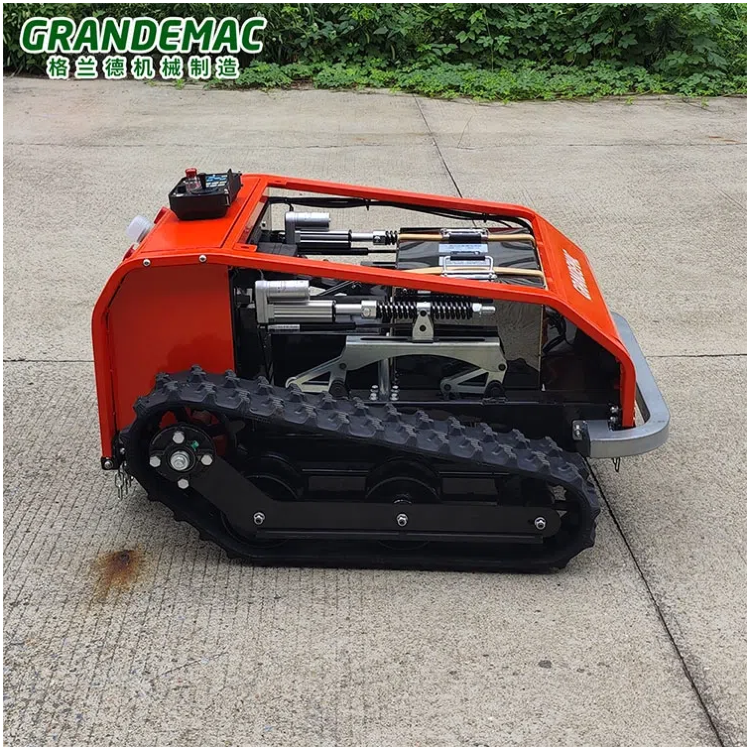
How to choose: 6 practical decision checkpoints
Lawn size and run-time planning
One of the most important factors is matching mower run-time to your yard size. A small battery-powered mower may suit a small suburban lawn but will require frequent charging for larger properties. Buyers should look at battery specifications, recharging times, and whether the mower supports automatic docking for recharging between tasks. For professional or semi-professional use, higher-capacity batteries or swappable battery packs are worth considering. Some brands even provide modular batteries compatible with other agricultural tools, offering greater operational efficiency.
Slope rating and traction capability
Mowers are rated for slope handling, often expressed in degrees such as 20° or 30°. A 20° slope rating means the mower can safely climb and operate on moderate hills, while a 30° rating suits steeper terrain. Traction systems—rubber treads, large wheels, or steel tracks—add further stability. For properties with significant elevation changes, choosing the right slope rating ensures safety and prevents stalling. Ignoring this factor could lead to underperformance, unnecessary wear, or even safety hazards.
Obstacle density and sensor needs
Not all lawns are free of obstacles. Properties with children’s toys, irrigation hoses, garden beds, or trees require mowers with advanced sensors. Simple bump sensors may suffice for flat, open lawns, but LiDAR or camera-equipped models are essential for more complex environments. Buyers should match sensor sophistication with the density of objects in their yards. In professional settings, better sensors reduce downtime caused by manual clearing, which directly translates to higher productivity.
App integration, mapping, and maintenance
Modern lawn mowers increasingly include mobile app control, allowing users to set mowing schedules, track progress, and view maintenance reminders. Mapping features, such as creating digital yard zones, provide greater customization. Maintenance overhead should also be considered—while most robot mowers require simple blade changes and battery checks, professional-use models may demand more regular servicing. A mower that balances automation with manageable upkeep ensures long-term convenience. GRANDEMAC focuses on developing products with user-friendly designs, ensuring that even advanced technologies remain accessible and simple to maintain.
Safety and legal considerations
Child and pet safety features
Safety remains a top concern when using any lawn mower. Buyers should look for models with built-in emergency stop functions, tilt sensors, and geofencing capabilities to restrict operation within defined boundaries. Some advanced models also detect movement from pets or children and stop immediately. For families, these features are not optional—they are essential to prevent accidents. GRANDEMAC places strong emphasis on integrating robust safety systems to protect both operators and bystanders.
Local regulations and HOA rules
Before purchasing, homeowners should check local regulations or homeowner association (HOA) rules. Some communities restrict noise levels, and although robot mowers are generally quiet, it is important to verify compliance. Others may require specific safety certifications for remote-controlled equipment. Understanding local requirements avoids potential conflicts and ensures a smooth ownership experience.
Quick shopping checklist
8-point buyer checklist
When narrowing down choices, buyers can use this checklist as a quick reference:
Match mower size and battery capacity to yard size.
Confirm slope rating is adequate for your terrain.
Evaluate sensor technology against yard complexity.
Consider run-time and charging convenience.
Check warranty terms and availability of spare parts.
Review noise level ratings, especially for residential areas.
Ensure app and mapping functions meet your expectations.
Verify compliance with local rules or HOA restrictions.
Conclusion
Selecting the right lawn mower is about more than budget—it’s about matching navigation technology and slope capability to your yard’s unique conditions. With the expertise of Jiangsu Grande Machinery Manufacturing Co., Ltd. (GRANDEMAC), buyers can access innovative mowing solutions designed for durability, safety, and performance in both residential and professional environments. If you are looking for a smarter, safer, and more efficient way to manage your property, GRANDEMAC can provide the right mower to match your needs. To learn more about our advanced mower models or to discuss the right fit for your property, contact us today.


