When it comes to managing modern yards, the choice of a lawn mower is no longer just about cutting grass—it’s about choosing between control and convenience. Homeowners and professional landscapers are increasingly comparing remote-controlled mowers with autonomous robotic models to decide which best fits their terrain, schedule, and budget. At Jiangsu Grande Machinery Manufacturing Co., Ltd. (GRANDEMAC), we design equipment that reflects both innovation and practicality, and understanding the difference between these two types of lawn mowers helps buyers make the right investment.
Side-by-side: workflow and user effort
Remote-controlled: hands-on precision for complex tasks
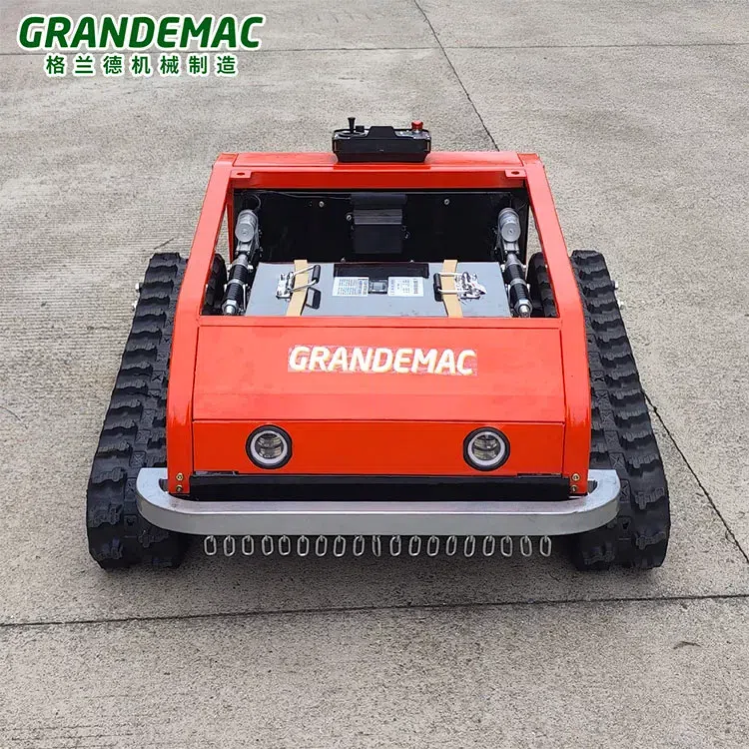
A remote-controlled lawn mower allows the operator to stay in the loop. By guiding the mower with a handheld controller, users can carefully navigate uneven slopes, orchards, or dense brush where every maneuver matters. This hands-on approach ensures precision cutting even in areas with obstacles like trees, garden beds, or irrigation lines. Landscapers who handle varied jobs value this control because it reduces the risk of damage while delivering a neat and consistent finish.
Unlike standard push mowers, remote-controlled machines are often equipped with durable tracks or wheels designed to handle rough ground. This makes them highly versatile for agricultural and landscaping applications where traditional methods might fail. Many professional users also appreciate that the learning curve is relatively short: with just a few minutes of practice, operators can control the mower confidently.
Autonomous robot: set-and-forget convenience
An autonomous robotic mower operates differently—it is designed for simplicity and minimal human input. Once installed and programmed, these machines follow pre-set schedules and rely on boundary wires, GPS, or LiDAR to cut automatically. For homeowners with flat, open lawns, this option is appealing because it keeps the grass trimmed without requiring regular supervision. It represents low-maintenance yard care, ideal for people who want to free up time while maintaining a consistently manicured look.
Over time, the value of an autonomous mower lies in consistency. Even if the owner is traveling or busy, the machine continues working, creating a smooth and uniform lawn appearance that rivals professional landscaping services. This is particularly attractive for residential areas where aesthetics matter on a daily basis.
Pros and cons: practical factors to weigh
Time savings, precision, cost, complexity, maintenance
Remote-controlled mowers excel in precision and adaptability. They save time for users managing challenging areas, though they require more active engagement during use. Autonomous mowers save the most time over the long term because they handle mowing independently, but they can be less precise in tricky zones. Cost-wise, remote-controlled machines are often more affordable initially, while robotic mowers involve higher upfront investment. Maintenance requirements differ as well: remote-controlled models typically have straightforward service needs, while autonomous units require battery monitoring, sensor calibration, and occasional software updates.
For households or businesses that demand total reliability, these trade-offs become crucial. Precision and adaptability are invaluable in complex environments, while time savings and automation are attractive in more uniform landscapes. Understanding the balance helps ensure the mower delivers real value instead of frustration.
Where each type struggles
Each system has limitations. Remote-controlled mowers depend on line-of-sight and operator attention; they are less efficient for very large, simple lawns. Autonomous mowers may face GPS drift under dense tree cover, struggle with steep slopes, or encounter difficulties around irregular obstacles. These challenges can affect cut quality and user satisfaction, making it important to match the mower type with the environment.
Another point is environmental impact. Remote-controlled models can be powered by gasoline or electric motors, offering flexibility but sometimes involving higher fuel use. Autonomous mowers are almost exclusively battery-powered, which reduces emissions but requires reliable charging infrastructure.
Cost, ROI and maintenance comparison
Upfront vs long-term investment
Remote-controlled lawn mowers typically involve lower upfront costs. Their parts are mechanical, their technology simpler, and they don’t rely heavily on advanced sensors. Over time, maintenance includes blade replacement, occasional engine or motor servicing, and normal wear and tear. Autonomous mowers demand higher initial spending due to advanced navigation systems, but their value comes from reducing the need for human effort. Owners should factor in battery replacements every few years and periodic service on electronic components.
For businesses, the return on investment varies. Landscapers who use remote-controlled mowers can reduce labor time in hard-to-reach areas and improve safety by keeping workers away from dangerous slopes. Homeowners with autonomous units enjoy long-term savings on professional lawn care services, though the payoff may take several years depending on lawn size.
Spare parts and local service availability
Another critical consideration is service accessibility. Remote-controlled models use widely available spare parts, making local repairs straightforward. Autonomous machines, on the other hand, often require brand-specific servicing, which may be limited in certain regions. For buyers in agricultural or suburban markets where service networks are still developing, the ability to source replacement parts quickly makes remote-controlled mowers more practical. At GRANDEMAC, our supply chain is designed to support global buyers with strong after-sales parts availability and responsive service.
Installation and setup: what to expect
Boundary wires vs GPS/LiDAR setup
Remote-controlled mowers require almost no setup beyond charging and starting the machine. Autonomous robotic mowers demand more preparation. Basic models need boundary wires installed around the lawn, a process that can take hours and requires some skill. Advanced robotic versions use GPS or LiDAR mapping, which is faster but requires technical understanding and may involve calibration. While this effort pays off in automation, buyers should be ready for an initial learning curve.
In both cases, users should also consider storage and charging. Remote-controlled models need a sheltered space for safe storage and occasional refueling or charging. Autonomous models often include docking stations, which must be installed in a convenient yet weather-protected location.
Which mower fits: four buyer scenarios
Best for small flat lawns
For compact, flat lawns with minimal obstacles, an autonomous mower is a strong choice. Once programmed, it quietly maintains the yard without constant attention. Owners who value convenience above all else will appreciate this solution.
Best for large, complex yards
If a property includes trees, garden beds, or irregular zones, a remote-controlled mower proves more efficient. It allows the operator to guide the machine into tight spaces and adapt instantly to changing conditions.
Best for slopes and brush
Steeper terrain and brush areas are unsafe for autonomous robots. Remote-controlled models, built with stability and powerful traction, are safer and more reliable in these conditions. They allow the operator to keep control while tackling rugged ground.
Best for professional landscapers
Commercial landscapers often manage varied terrains. Remote-controlled mowers offer the flexibility they need to handle orchards, slopes, and obstacles. However, for businesses specializing in flat, residential properties, autonomous fleets can maximize productivity with less labor. Some landscapers even use a combination of both, ensuring they are prepared for every type of client requirement.
Conclusion
Deciding between a remote-controlled lawn mower and an autonomous robotic mower ultimately comes down to the unique needs of the yard and the priorities of the user. Those who value precision, adaptability, and safety on uneven ground will find remote-controlled mowers to be the more dependable option. Meanwhile, homeowners seeking low-maintenance solutions for flat, open spaces will enjoy the quiet efficiency of autonomous models. Both technologies offer advantages, but only when matched with the right environment do they deliver their full value.
At Jiangsu Grande Machinery Manufacturing Co., Ltd. (GRANDEMAC), we understand these differences and build equipment designed to serve real-world users across agricultural, landscaping, and residential markets. Our mission is not only to provide machinery but also to help customers select the right solutions that balance cost, convenience, and long-term performance. If you are considering upgrading your lawn care equipment, exploring the strengths of both remote-controlled and autonomous options is the first step toward making a smart investment. For professional guidance and details about our product line, please contact us directly—we are ready to support your needs with reliable technology and service.


