Moving heavy agricultural harvests across steep inclines exposes standard farm logistics to severe limits. Navigating muddy orchard floors demands equipment built for hostile realities. Standard wheels often sink or spin out in these environments. Choosing between tracks and wheels goes beyond basic surface mobility. This choice directly impacts long-term soil health. It also dictates operator safety and facility maintenance downtime.
Standard pneumatic tires create damaging ruts in wet zones. Specialized continuous treads distribute weight evenly across fragile ground. This guide provides an objective, side-by-side evaluation of both drive systems. We base this comparison on terrain realities and physical implementation requirements. You will learn how payload efficiency pairs with terrain physics. We will help you evaluate these machines to finalize your equipment procurement with total confidence.
Key Takeaways
Wheeled carriers offer superior speed and lower lifetime maintenance costs but struggle on slopes exceeding 15 degrees and in highly saturated soils.
A tracked transport vehicle minimizes soil compaction through low ground pressure and provides critical stability for mountain farming, though it requires a higher initial investment.
The choice ultimately hinges on a localized matrix: specific terrain gradient, annual rainfall, load capacities, and available on-site maintenance expertise.
Emerging autonomous solutions are shifting the landscape, with the orchard transport robot category bridging the gap between heavy payload capacity and precision navigation.
Assessing the Terrain Disconnect: Why Standard Vehicles Fail in Orchards
Orchard environments present unique logistical hurdles. These challenges rapidly degrade the performance of standard transport vehicles. We must evaluate the specific physical limitations imposed by agricultural terrain.
The Soil Compaction Problem
Repeated equipment passes severely impact soil architecture. Pneumatic tires concentrate machine weight onto very small contact patches. This high-pressure contact compresses the topsoil layer. Over time, it creates a dense hardpan layer beneath the surface. This hardpan restricts critical root expansion in perennial orchards. It also prevents proper water infiltration. Rainwater runs off instead of reaching the root zone. Poor absorption leads to localized flooding and nutrient runoff. Healthy orchards require porous soil. Heavy point-loading directly threatens this delicate ecological balance.
Slope and Traction Realities
Mountain farming completely alters operational physics. Slopes drastically shift a vehicle's center of gravity. A high center of gravity increases rollover risks on uneven terrain. Surface contact area directly dictates slip rates during wet seasons. Wet clay or morning dew heavily reduces available friction. Standard wheels easily lose grip under these conditions. Once traction breaks, machines slide unpredictably. This endangers the operator and the surrounding crop infrastructure. Managing these slopes requires specific mechanical adaptations.
Success Criteria for Transport
A successful transport solution requires a specific balance. First, it must deliver high payload efficiency. You need to move maximum tons per hour. Second, the machine must cause minimal ecological disruption. It cannot destroy the soil it operates on. Finally, it must guarantee maximum operator safety. Equipment must remain stable on slopes and predictable in mud. Failing any of these criteria renders the vehicle unsuitable for modern agricultural demands.
The Case for Wheeled Carriers: Speed, Resource Efficiency, and Firm Ground
Wheeled carriers remain the dominant choice for many agricultural operations. Their design excels in specific, well-managed environments.
Core Mechanics
Wheeled systems rely on pneumatic or solid rubber tires. These round structures carry the entire vehicle load on four small contact footprints. Pneumatic tires deform slightly over bumps. This deformation absorbs minor shocks. Solid tires resist punctures completely but transfer more vibration to the chassis.
Primary Advantages
Higher top speeds: Wheels spin freely with minimal mechanical resistance. They allow rapid transit between flat fields and storage facilities.
Minimal vibration on hard surfaces: Pneumatic tires provide natural suspension on hard-packed dirt or gravel. This significantly reduces operator fatigue during long shifts.
Operational Limitations
Wheeled systems face severe limitations outside their ideal zones. They carry a high risk of rutting in muddy conditions. The narrow tires slice through soft topsoil easily. They also suffer massive traction loss on wet grass. Steep inclines amplify this wheel spin. When wheels spin, they dig deeper into the earth. This often leaves the vehicle high-centered and completely immobilized.
Ideal Deployment Scenarios
Wheeled machines excel in mature, flat orchards. They work best on established pathways and manicured rows. Dry climates suit them perfectly. Operations requiring frequent road travel benefit greatly from wheeled efficiency. If your farm consists of flat, dry land, wheels provide unmatched transit speed.
Tracked Transport Vehicle Operations: Conquering Slopes and Soft Soil
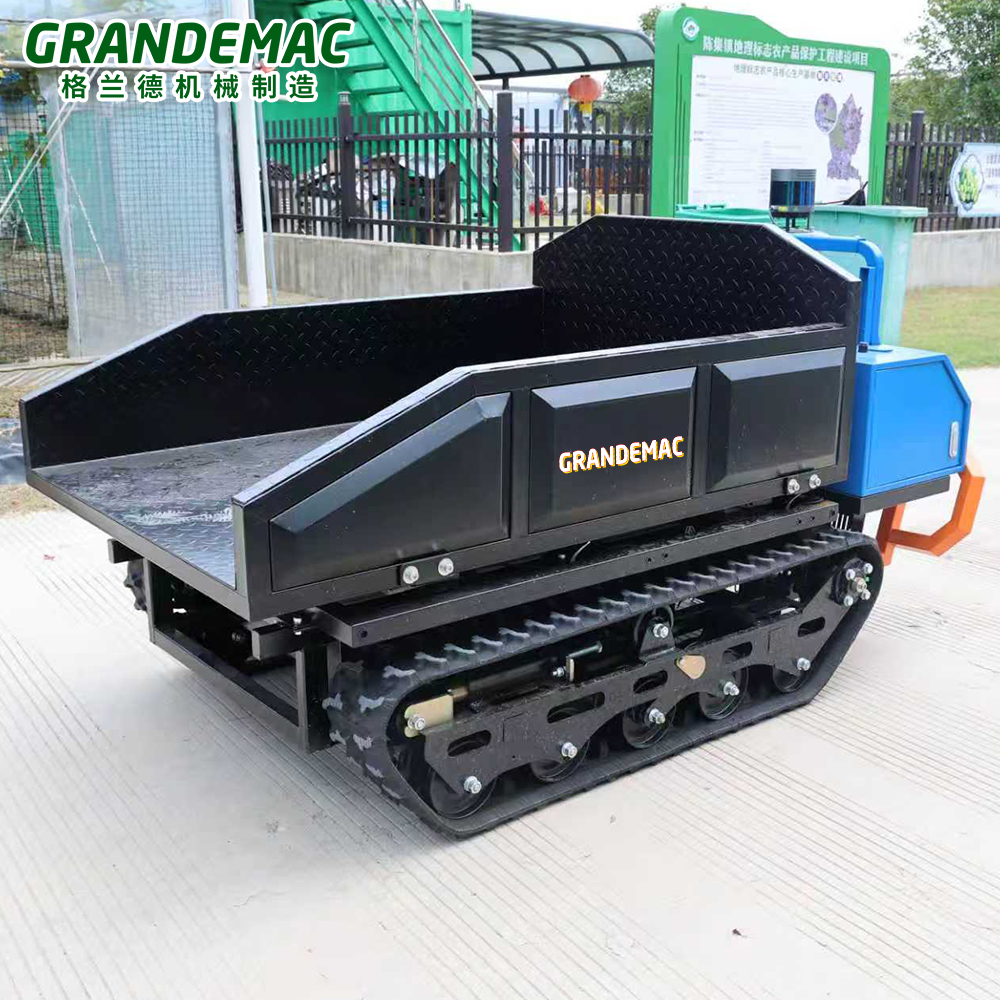
Rugged terrain demands specialized mechanical solutions. Tracked systems fundamentally change how machines interact with the earth. By deploying a tracked transport vehicle, farmers can operate in environments that destroy standard trucks.
Core Mechanics
These machines use continuous track systems. Agriculture heavily favors reinforced rubber tracks over steel variants. These continuous loops disperse the entire machine weight over a massive surface area. Instead of four small contact points, tracks lay down a long, wide footprint. This mimics a floating effect over soft ground.
Primary Advantages
Floatation and Low Ground Pressure: Tracks prevent deep rutting entirely. They protect delicate orchard root systems even in wet, boggy conditions. The ground pressure often rivals that of a human foot.
Maximum Gradeability: Tracks deliver superior mechanical grip. They pair this with a very low center of gravity. These features make track systems the gold standard for hillside and terraced mountain farming.
Operational Versatility: Farmers easily adapt these chassis for multiple roles. For example, a crawler dumper vehicle moves bulk fertilizers, heavy soil, and large harvest bins effortlessly over uneven ground.
Implementation Risks and Logistics
Tracked systems do carry distinct operational trade-offs. They demand a higher upfront procurement investment. The undercarriage contains numerous moving parts. Frequent driving on abrasive surfaces causes accelerated wear. Concrete or asphalt quickly degrades track lugs, idlers, and rollers. Furthermore, tracks mandate slower transit speeds between disparate farm zones. You must factor this slower transit into your daily harvest schedules.
Head-to-Head Evaluation Framework: Tracks vs. Wheels
Choosing the correct platform requires direct comparison. We must measure both systems across specific performance metrics and safety standards.
Performance Metrics Comparison
Traction vs. Speed: Tracks win decisively on raw pull. They drastically reduce slip rates in mud. Wheels win on cycle times across flat, hard ground. If distance and speed matter most, wheels excel. If pulling heavy loads through mud matters most, tracks dominate.
Payload-to-Weight Ratio: Tracks allow for much heavier loads in marginal conditions. A wheeled truck might sink under a two-ton payload in wet clay. A tracked machine carries that same payload across the clay without sinking. The continuous footprint provides necessary buoyancy.
Equipment Performance Comparison Chart
Feature Matrix
Wheeled Carriers
Tracked Vehicles
Ground Pressure
High (Prone to rutting)
Very Low (Excellent floatation)
Max Slope Safety
Up to 15 degrees
Exceeds 25+ degrees safely
Transit Speed
Fast (Ideal for roads)
Slow to Moderate (Field focused)
Turning Radius
Wide (Requires turnarounds)
Zero-turn capable
Maintenance and Lifecycle Logistics
Scheduled maintenance differs wildly between platforms. Wheeled systems primarily require checking tire pressures and monitoring tread depth. Tracked undercarriages demand rigorous daily attention. Operators must grease numerous tensioning cylinders and bogey wheels. You must clear debris from the track assembly daily. Neglecting this causes premature track snapping.
Lifespan expectations vary based on surface abrasion. Heavy-duty agricultural tires can last several seasons on mixed terrain. Rubber agricultural tracks offer immense field longevity but degrade rapidly if driven on paved roads. Operating tracks on abrasive concrete can reduce their lifespan by half.
Safety and Compliance
Agricultural safety compliance requires strict adherence to local regulations. OSHA and regional safety boards heavily regulate equipment on slopes. Rollover protection systems (ROPS) remain mandatory. Tracks offer a wider, inherently more stable footprint. This dramatically reduces the machine's tipping point on steep grades. Using tracked systems reduces operational liability in challenging mountain applications. They provide operators with a secure, planted feel when traversing dangerous hillsides.
Scaling into the Future: Automation and Autonomous Carriers
Agricultural logistics faces severe labor shortages globally. Modern farms rapidly move beyond manual driving to solve this crisis. Automation represents the next major leap in orchard management.
Bridging the Labor Gap
Finding qualified operators for hazardous mountain terrain proves increasingly difficult. Automated systems remove the human element from dangerous slope navigation. They operate continuously, bridging the gap between harvest demands and available manpower. These machines execute repetitive transit loops flawlessly.
The Rise of Autonomous Platforms
Autonomous technology currently merges with both wheel and track chassis. A modern orchard transport robot represents the peak of this integration. Manufacturers deploy wheeled robots for flat, manicured rows. They deploy tracked robotic chassis for rugged, unpredictable terrain. These smart platforms balance heavy payload capacities with precision row navigation.
Evaluation for Tech Adoption
Adopting automated carriers requires specific site evaluations. You must assess your farm's technological infrastructure.
GPS/RTK Signal Availability: Autonomous machines rely on Real-Time Kinematic positioning. Thick tree canopies block satellite signals. You must ensure signal continuity across your orchard.
LiDAR Capabilities: Operations need robust obstacle avoidance. LiDAR sensors detect fallen branches, workers, or deep washouts. Evaluate the sensor resolution before shortlisting any robotic carrier.
Network Redundancy: Remote farms often lack strong cellular coverage. Localized mesh networks ensure continuous communication with the autonomous fleet.
The Buyer’s Decision Tree: Shortlisting Your Next Vehicle
Selecting the right equipment requires a systematic approach. Follow this decision tree to eliminate unsuitable options.
Execute a Terrain Audit: Walk your farm during the wettest season. If operations occur on slopes exceeding 15 degrees, default to tracks. If you encounter consistently wet clay, default to tracks. If your terrain remains flat and dry year-round, default to wheels.
Assess Pathway Infrastructure: Measure your row widths. Determine the required turning radiuses at the end of each row. Wheeled machines need wide turnaround zones. Tracked systems frequently execute zero-radius turns. This makes tracks vastly superior for tight, high-density orchard configurations.
Evaluate Maintenance Reality: Be brutally honest about your on-site mechanical skills. Tracked systems demand consistent undercarriage maintenance. Ensure you have the mechanical resources and local dealer support before committing to a tracked fleet. If you lack specialized mechanics, wheels offer simpler upkeep.
Next Steps: Never purchase heavy equipment based solely on brochures. Recommend requesting on-site, fully loaded demonstrations. Schedule these demos during the farm's worst seasonal weather conditions. Validating manufacturer claims in your specific mud and slope conditions guarantees a correct purchase.
Conclusion
The debate between tracks and wheels yields no universal winner. The better choice remains strictly dictated by your geographical realities and operational priorities. Wheeled vehicles prioritize transit efficiency on compliant terrain. They offer simplicity and rapid movement across dry, flat expanses. Conversely, tracked systems prioritize access, safety, and crucial soil protection in hostile environments. They conquer steep slopes and muddy bogs safely.
To finalize your strategy, evaluate your specific farm parameters. Calculate your acceptable downtime during wet seasons. Assess the physical repair requirements for your soil. Establish these parameters first, then reach out to manufacturers for site-specific payload demonstrations. Seeing the equipment perform on your hardest terrain makes the final choice obvious.
FAQ
Q: What is the average lifespan of agricultural rubber tracks compared to tires?
A: Agricultural rubber tracks generally last between 1,500 and 3,000 hours of field operation. Their lifespan heavily depends on surface abrasion. Driving tracks on asphalt drastically reduces this lifespan. Heavy-duty pneumatic tires often exceed 4,000 hours, provided they avoid severe puncture hazards in the field.
Q: Can a crawler dumper vehicle be modified for automated orchard spraying?
A: Yes. Many modern crawler platforms feature modular attachment systems. You can remove the dumper bed and install automated spraying rigs. Ensure the base machine possesses adequate Power Take-Off (PTO) or auxiliary hydraulic flow to support the heavy demands of commercial spray pumps.
Q: How do I calculate ground pressure for my specific orchard soil type?
A: You use a basic physics formula. Add the empty vehicle weight to your maximum payload weight. Divide this total weight by the total surface contact area of the tracks or tires. This provides the Pounds Per Square Inch (PSI) exerted on your specific soil.
Q: Are tracked vehicles significantly harder to maintain on a remote farm?
A: They require more specialized attention. Standard tire punctures require basic patches or plugs. Conversely, tracks demand daily greasing, rigorous debris removal, and specialized heavy-duty track-tensioning tools. Remote farms must stock spare idlers and possess the heavy lifting equipment needed to reset a derailed track safely.