If you manage an orchard, vineyard, or a small mixed farm, you already know that “bigger” doesn’t always mean “better.” In tight rows, around trellises, on uneven headlands, or between irrigation lines, a compact tractor that turns easily and keeps traction can outperform a larger machine that feels bulky and hard to control. That’s why so many growers ask us about a 25hp mini 4WD wheel tractor—and especially how it fits real orchard tasks. From our manufacturing and customer feedback experience, the value of a compact 4WD model isn’t just its horsepower. It’s the balance of maneuverability, stability, and usable traction, combined with the ability to run the most common implements that orchard work requires.
In this article, we’ll break down the best applications for a 25hp mini 4WD wheel tractor, where it shines compared with larger or 2WD machines, and how to match the tractor to your actual daily workflow. We’ll also share a practical table to help you visualize which tasks are the best fit, what attachments you may need, and what to watch for when planning your equipment lineup.
Why 25hp + 4WD is a practical “sweet spot” for orchard work
A 4WD farm orchard tractor in the 25hp range is usually chosen for one reason: it’s small enough to work efficiently in constrained spaces, but strong enough to do more than just towing. In orchards, you’re often dealing with:
Wet grass after irrigation or dew
Soft soil in shaded rows
Frequent stop-and-go operations
Tight turning at row ends
Sensitive root zones where wheel slip creates ruts
In these conditions, 4WD improves control and reduces wheel slip. That means better work quality (mowing, spraying, mulching) and fewer time losses caused by traction issues.
Best applications for a 25hp mini 4WD wheel tractor
1 Orchard mowing and cover-crop management
If there’s one job compact tractors do constantly, it’s mowing. A 25hp mini 4WD wheel tractor is well matched to:
Orchard floor mowing between rows
Grass control under trellises and along fence lines
Light brush cutting (depending on implement)
Managing cover crops for soil health and erosion control
Why 4WD matters here: mowing often happens when the ground is slightly damp. With 2WD, you can lose traction on slopes or soft patches. With 4WD, the tractor keeps a steady pace and reduces turf damage caused by wheel spin.
2 Spraying support in narrow rows
Many orchard and vineyard operations use airblast sprayers or smaller sprayers depending on canopy height and row spacing. A 25hp mini 4WD wheel tractor is commonly used for:
Pulling small to mid-size sprayers
Maintaining stable speed for consistent coverage
Working in narrow row spacing where a larger tractor struggles
The key advantage is controlled traction. When the tractor holds speed smoothly, the spray pattern is more consistent. And when the ground is uneven, 4WD reduces the risk of getting stuck mid-row.
3 Light hauling and bin transport
Harvest seasons create short, intense logistics windows. A compact 4WD tractor can be very effective for:
Hauling empty or partially loaded bins
Pulling small trailers inside the orchard
Moving supplies, irrigation materials, and tools
In wet or loose ground, 4WD helps you move loads with fewer stops and less wheel slip. It also improves steering response when towing.
4 Mulching, shredding, and orchard sanitation
Orchard sanitation can involve pruning residue, leaf litter, and organic debris. With the right implement match, a 25hp mini tractor can support:
Practical note: implement sizing matters. A compact tractor can do excellent sanitation work, but you’ll want to match mower/mulcher width and required PTO power carefully.
5 Light tillage and soil preparation for small plots
In orchards, heavy tillage isn’t always desired, but certain tasks still benefit from compact tractor capability:
Light rotary tilling in small garden plots or nursery areas
Soil preparation for replanting sections
Managing small vegetable blocks adjacent to orchard land
4WD improves traction in disturbed soil, especially when using ground-engaging implements.
6 Maintenance work around the farmyard and facilities
A 25hp mini 4WD wheel tractor is also a reliable “daily utility machine” for:
Yard grading and light leveling (with a rear blade or box blade)
Snow clearing (in applicable regions)
Material handling with a small loader (depending on configuration)
Moving pallets or bags with fork attachments
For many farms, this versatility becomes the real return on investment—because the tractor is used year-round, not just during one seasonal operation.
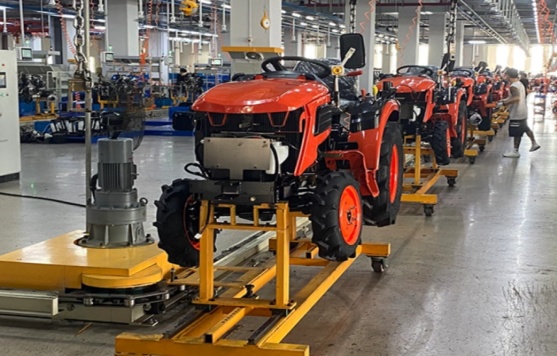
Quick fit guide: tasks, implements, and why 4WD helps
Application | Typical implement | Why a 25hp mini 4WD wheel tractor fits | Practical tip |
Orchard mowing | Flail mower / rotary mower | Stable speed + better traction on damp rows | Choose width that matches row spacing |
Spraying support | Small sprayer / air-assisted sprayer | Controlled movement improves coverage | Check towing weight and braking |
Bin and trailer hauling | Small trailer | 4WD reduces slip in soft ground | Use proper hitch height for stability |
Mulching/sanitation | Light mulcher / shredder | Maneuverable in tight headlands | Match PTO power to implement load |
Light soil work | Rotary tiller | 4WD improves traction in loose soil | Avoid overworking wet soil |
Yard maintenance | Rear blade / box blade | Compact + enough pull for grading | Add ballast if needed |
Seasonal clearing | Broom / blade | Handles mixed surfaces better | Consider tire type for traction |
Where a 25hp mini 4WD is better than a larger tractor
This may sound counterintuitive, but in many orchard settings, smaller is more productive:
Tight row spacing: less risk of branch damage and trunk contact
Lighter weight: can reduce compaction in sensitive areas
Sharper turning: faster work at row ends
Easier transport: simpler logistics between blocks
A larger tractor may have more power, but if it cannot move comfortably between rows or causes frequent maneuvering corrections, the “extra horsepower” doesn’t turn into real productivity.
Where a 25hp mini 4WD is not the right tool
We also want to be realistic. A 25hp mini 4WD wheel tractor is not designed for:
Heavy subsoiling or deep ripping
Large, heavy airblast sprayers with full tanks
High-speed road transport with heavy loads
Large-scale field plowing
If your operation relies heavily on these tasks, you may need a higher horsepower tractor—or a two-tractor strategy: one compact orchard unit and one larger field unit.
How to choose the right configuration for orchard work
When customers ask us what makes a compact tractor “orchard-ready,” we usually focus on these points:
Overall width and turning radius
The tractor should fit your row spacing with margin for operator comfort.
4WD traction and tire selection
Tire type (ag, turf, industrial) affects grip and soil impact.
PTO and hydraulic capability
Your implements need stable PTO speed and enough hydraulic flow for lifting and control.
Stability and safety
Low center of gravity, proper ballast strategy, and rollover protection.
Transmission options
Orchard work benefits from smooth low-speed control for spraying and mowing.
Our perspective as a manufacturer
At Jiangsu Grande Machinery Manufacturing Co., Ltd., we see compact orchard tractors as “high utilization” machines: they do many tasks, many days a year, and their value comes from reliability and versatility more than headline horsepower. A 4WD farm orchard tractor in the 25hp class is often chosen by growers who want one machine that can handle mowing, light hauling, sprayer support, and daily maintenance without being oversized for the orchard environment. When the machine is sized correctly for your row spacing and your implement set, it becomes a dependable partner rather than a seasonal tool.
Conclusion
A 25hp mini 4WD wheel tractor is most effective in the jobs that define orchard and small-farm daily reality: mowing, sprayer support, light hauling, sanitation work, and facility maintenance. Its advantage is not just power—it’s control in tight spaces, dependable traction in changing ground conditions, and implement versatility that keeps the machine productive across seasons. If your operation includes narrow rows, damp orchard floors, frequent turning, and time-sensitive seasonal tasks, a 4WD farm orchard tractor in this size range can be one of the most efficient equipment decisions you make.
If you’d like to match a compact 4WD model to your orchard row spacing, terrain, and implement list, you can learn more from Jiangsu Grande Machinery Manufacturing Co., Ltd. and contact our team for practical configuration suggestions based on real working conditions.
FAQ
1) What jobs are best for a 25hp mini 4WD farm orchard tractor?
Common best-fit jobs include orchard mowing, sprayer towing, light trailer hauling, sanitation mulching, and yard maintenance—especially in tight rows.
2) Is 25hp enough for spraying in orchards?
For small to mid-size sprayers, yes. The key is matching sprayer weight and pump requirements to your tractor’s towing capacity and PTO power.
3) Why choose 4WD instead of 2WD for a compact orchard tractor?
4WD improves traction on wet grass and soft soil, reduces wheel slip, and provides better steering control when towing implements in orchards.
4) Can a 25hp mini 4WD wheel tractor handle a front loader?
It can, depending on the model configuration. For loader work, proper ballast, tire choice, and safe lifting practices are essential for stability.


