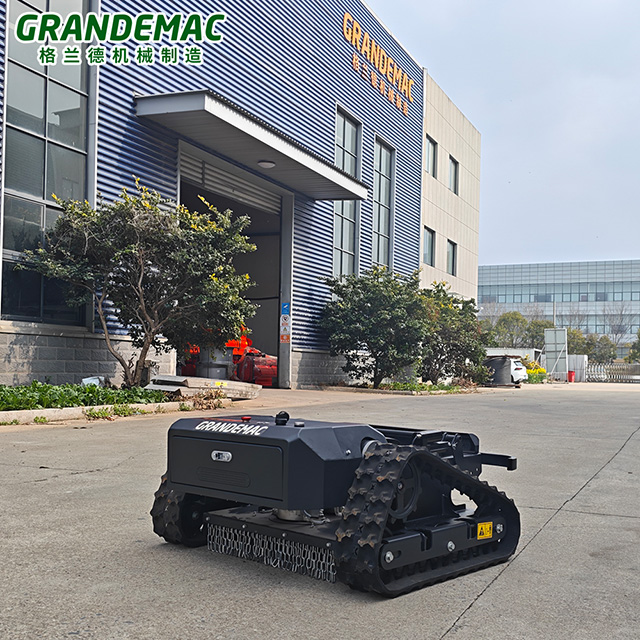
Operating heavy machinery on steep or unstable ground presents critical safety liabilities. Commercial landscapers and property managers constantly face severe labor inefficiencies when managing difficult landscapes. Moving standard equipment across treacherous hillsides simply invites disaster. Traditional ride-on mowers face strict slope limits, typically capping at 15 to 20 degrees. Pushing past these physical boundaries creates severe rollover risks. It also causes immediate engine oil starvation. Because of these hard limits, complex terrains typically rely on slow manual labor and extensive string trimming.
A commercial-grade Remote Control Lawn Mower easily bridges the gap between operator safety and raw terrain capability. This complete guide breaks down exact terrain thresholds, vital engineering limitations, and essential evaluation criteria. We will help you determine exactly if this advanced equipment perfectly fits your toughest operational needs.
Key Takeaways
Slope Dominance: Remote-operated mowers safely manage slopes between 40° and 50°, keeping operators safely stationed on flat ground.
Traction & Ground Pressure: Tracked chassis designs distribute weight efficiently, allowing operation in soft, muddy, or heavily rutted environments without destroying turf or getting stuck.
Technology Alignment: While RTK robotic mowers excel on mapped, predictable lawns, remote control units are purpose-built for unpredictable, heavy-brush, and high-risk topography.
ROI & Safety: Deploying solutions like the RM20 Remote Control Lawn Mower eliminates worker compensation risks associated with slope falls while cutting clearing times by up to 60%.
The Terrain Challenge: Where Traditional and Ride-On Mowers Fail
Industry safety organizations like OSHA outline strict slope limits for standard landscaping equipment. Ride-on zero-turn mowers enter a high-risk danger zone anytime they exceed a 15-degree incline. Operators riding atop these machines face severe rollover hazards. Gravity easily shifts the high center of mass on steep hills. When a heavy mower flips, it traps the operator underneath. You simply cannot ignore these massive compliance risks when bidding on commercial terrain contracts.
Mechanical limitations also prevent standard mowers from conquering hills. Most gas-combustion engines rely on splash lubrication systems. They need a level oil pan to function correctly. When you drive a standard mower sideways across a 25-degree hill, the oil shifts rapidly away from the pump pickup tube. We call this engine oil starvation. The internal components lose critical lubrication instantly. The engine overheats, scores the cylinder walls, and eventually seizes completely under prolonged incline exposure.
Landscapers often fall back on manual labor to bypass these machine limits. You likely deploy large crews equipped with heavy string trimmers. They must physically hike up embankments, balance near ditches, and edge along precarious retaining walls. This manual alternative creates an enormous physical toll on your workforce. Slips and falls cause frequent worker compensation claims. Furthermore, manual weed whacking is incredibly inefficient. A human crew clears heavy brush exponentially slower than automated machinery. Relying on hand-held tools ruins your daily productivity metrics.
Evaluating Capable Terrains for a Remote Control Lawn Mower
Extreme Slopes and Embankments
Many professionals confuse the degree of a slope and the percentage of a slope. You must understand this difference before tackling extreme hills. A 100% slope equals a 45-degree angle. Traditional equipment fails early, but a purpose-built remote mower thrives here. Their operational threshold comfortably sits between 40° and 50°.
They achieve this massive climbing capability through a remarkably low center of gravity. Engineers place the heaviest components inches from the ground. Wide track stances prevent sideways tipping entirely. Operators stand safely at the bottom of the embankment. You never put human weight on the tipping machine.
Uneven, Rutted, and Retaining Wall Edges
Rough terrain destroys standard mower decks. Hidden ruts, exposed rocks, and uneven ground easily trap zero-turn wheels. Tracked remote units utilize independent suspension systems to absorb these brutal shocks. The tracks flex over uneven terrain seamlessly.
This flexibility ensures the chassis remains stable while traversing deep ruts. It prevents the cutting blades from scalping the ground. You maintain aggressive traction without tearing the turf. When trimming near sharp retaining wall edges, tracks provide superior grip. You maneuver safely along the exact edge without risking a sudden drop-off.
Wet, Boggy, and Soft Soil Conditions
Ground pressure dictates whether a machine floats or sinks. We measure this metric in pounds per square inch (PSI). A standard human boot exerts about 8 PSI. Heavy wheeled mowers exceed this number drastically. They quickly sink into marshy retention ponds and post-rain ditches.
Lightweight tracked designs distribute their mass across a massive surface area. They often exert less than 3 PSI. They literally float over wet, boggy, and soft soil conditions. You can clear marshy wetlands without getting stuck. This low ground pressure completely prevents deep tire ruts in soft residential lawns.
Heavy Brush and Overgrown Vegetation
Complex topography usually features hostile plant life. You rarely find manicured grass on a 45-degree highway embankment. You find dense saplings, thick woody weeds, and waist-high grass instead. Standard rotary decks choke and stall when they hit this density.
Remote mowers offer specialized cutting capabilities for extreme overgrowth. Flail blade systems shatter woody brush upon impact. They mulch dense saplings into fine debris instantly. Heavy-duty rotary blade variants power through tall, thick weeds easily. They spin with immense torque, slicing through vegetation that stops traditional equipment dead in its tracks.
Remote Control Mowers vs. RTK Autonomous Robots for Complex Topography
The landscaping industry currently debates two major technological advancements. Buyers often confuse RTK autonomous robots and remote-operated machines. They serve entirely different topographical needs. You must align the right technology with your specific terrain.
RTK (Real-Time Kinematic) GPS mowers require absolute predictability. They navigate using direct line-of-sight connections to open sky satellites. They need clear, mapped boundaries to function. They experience immediate failure points under dense tree canopies. Deep ravines block their GPS signals entirely. Unpredictable, obstacle-heavy zones confuse their sensors and stall their progress.
We frame the remote control unit as a brute-force solution. It requires a human operator's direct judgment. An operator sees a hidden ditch and steers around it instantly. You safely navigate high-liability zones using human intuition. The machine conquers blind spots and variable vegetation density effortlessly. It does not wait for a satellite signal to tackle a steep hill.
Decision Matrix: Predictability & Precision vs. Power & Topographical Adaptability
Feature/Metric
RTK Autonomous Robots
Remote Control Mowers
Primary Navigation
GPS & satellite mapping
Direct human visual operation
Ideal Terrain
Flat, predictable, open lawns
Steep slopes, ravines, retaining walls
Vegetation Type
Standard turf grass
Heavy brush, saplings, dense weeds
Environmental Weakness
Tree canopies and signal dead-zones
Requires constant operator attention
Best Practice: Always deploy RTK robots for large, flat corporate campuses. Reserve your remote-operated units specifically for hazardous, unmapped, or heavily overgrown boundaries.
Common Mistake: Never assume an RTK robot can clear a forested hillside. Signal loss will strand the machine on a dangerous incline.
Engineering Factors That Dictate Terrain Limits (What to Look For)
You cannot judge a mower solely by its marketing claims. Real terrain limits depend heavily on internal engineering factors. You must inspect the drive systems closely before purchasing.
Electric drive motors offer massive advantages on extreme slopes. Traditional hydraulic drive systems risk fluid leaks when tilted aggressively. Electric drives eliminate this risk entirely. They provide instant torque to the tracks without relying on fluid dynamics. Even if you use a hybrid gas model for blade power, electric track motors guarantee you never suffer oil starvation in the drive system during extreme tilts.
Chassis and track design dictate your grip. Wide-stance chassis prevent lateral rolling. Deep-tread rubber tracks act as your primary erosion control mechanism. They grip loose shale and damp soil securely. You should strictly avoid wheeled remote mowers for serious slope work. Wheels create single pressure points that slip easily on slick hillsides.
Finally, you must evaluate built-in fail-safes and connectivity. Heavy machinery operating far from the user requires strict safety boundaries. Standard safety features should include automatic electromagnetic braking. If the remote signal drops unexpectedly, the machine must lock its tracks instantly. Advanced tilt-sensors provide another crucial fail-safe. If the machine accidentally exceeds safe operating angles, these sensors automatically cut blade power to protect the surroundings.
Site Evaluation: Is the RM20 Remote Control Lawn Mower Your Best Fit?
Every landscape requires a unique mechanical approach. You cannot deploy heavy machinery blindly. You must conduct a thorough site evaluation before committing to a new operational strategy. Proper site audits guarantee you purchase the correct equipment configuration.
You must measure three vital metrics during your site audit:
Maximum slope grade: Measure the steepest section of your property using a digital clinometer. Ensure it falls within the 40° to 50° range.
Primary vegetation type: Identify whether you mostly cut standard grass or woody brush. This determines your ideal blade type.
Ground softness: Check the soil moisture levels near drainage ditches to estimate required track displacement.
Once you map these metrics, you can evaluate specific machines. The RM20 Remote Control Lawn Mower directly addresses aggressive business outcomes. Its wide track width guarantees elite traction on 45-degree slopes. The intense power output shreds thick brush seamlessly. Its optimized fuel and battery efficiency easily supports full-day clearing operations without constant refueling interruptions.
However, you must transparently acknowledge implementation risks. Operators face a distinct learning curve. Driving via remote control feels different than steering a zero-turn. You must train your crew carefully. Daily maintenance expectations also shift. Operators must clear undercarriage debris frequently to prevent track derailments. Transporting tracked units requires heavy-duty ramps and secure trailer tie-downs before heading to the job site.
Conclusion
A remote-operated unit serves as an incredible investment in risk mitigation. It keeps your crew away from dangerous cliffs. It radically improves labor efficiency across hostile terrains. It eliminates the slow, grueling nature of manual weed whacking. However, it is not a direct replacement for flat-ground finishing mowers. You should deploy it strategically where traditional ride-on equipment simply fails.
Respect the physical limits of traditional ride-on mowers to avoid fatal rollovers.
Utilize tracked chassis designs to conquer 50-degree slopes and marshy soil.
Train your operators thoroughly on remote navigation and daily track maintenance.
Your next step is simple. Schedule a comprehensive site demo on your most difficult hillside. Calculate your current manual-labor slope-clearing costs against the purchase price of an RM20 unit. This direct comparison will quickly prove the immediate return on investment for your landscaping business.
FAQ
Q: What is the maximum slope a remote control lawn mower can handle?
A: Most commercial-grade remote mowers safely handle slopes up to 50 degrees. They achieve this extreme climbing limit through a very low center of gravity and a wide track stance. Pushing beyond 50 degrees risks breaking traction, which causes the machine to slide downhill rather than tip over.
Q: Do the tracks tear up the turf when turning?
A: Yes, aggressive counter-rotation can tear soft turf. Tracks grab grass heavily during zero-turn pivots. Operators mitigate this damage easily using proper driving techniques. They should perform gradual, wide three-point turns instead of spinning both tracks in opposite directions while stationary.
Q: How does remote signal range affect operation in hilly areas?
A: Most industrial remotes boast a range of roughly 200 meters. However, hilly terrain blocks direct line-of-sight, shortening this range. Signal interference causes modern machines to trigger an automatic shut-off safety feature. The electromagnetic brakes lock instantly if the connection drops, preventing runaway incidents.
Q: Can they cut in the rain or on wet slopes?
A: Yes, many units feature high IP waterproof ratings for their internal electronics. However, physical slip risks increase dramatically on wet grass. Even deep rubber tracks lose vital friction on soaked hillsides. You should avoid cutting on steep, wet slopes to maintain absolute operational safety.