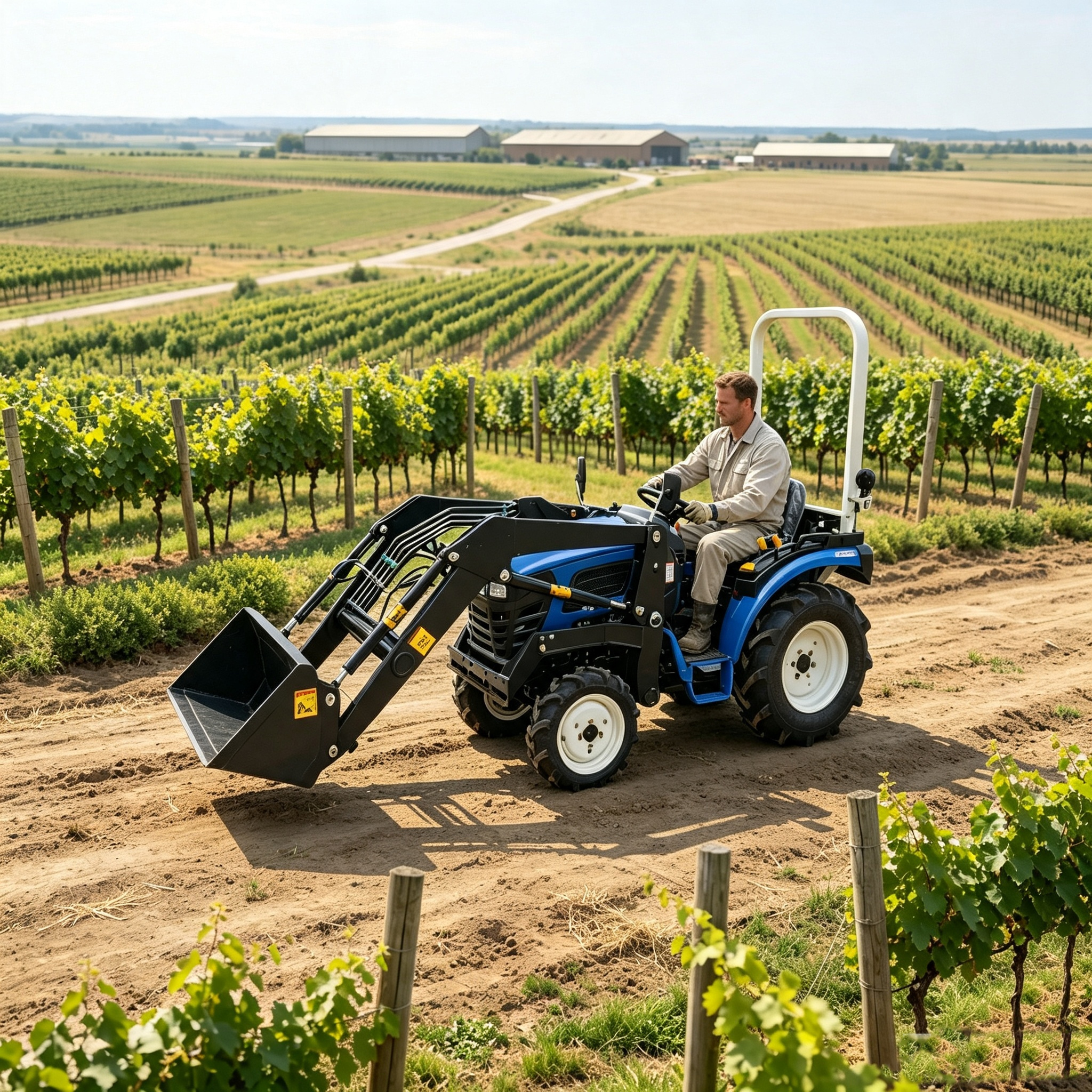
Agricultural models are shifting rapidly globally. High-density, narrow-row plantings effectively maximize yield per acre. Modern vineyards and high-yield apple orchards rely entirely on this tight spacing. Almond and cherry operations increasingly adopt these exact layouts. However, standard farm equipment struggles significantly here. Bulky machines routinely damage delicate canopies and deeply compact vital root zones. They also waste valuable operational hours maneuvering poorly on narrow headlands. You need a purpose-built Orchard tractor to solve this bottleneck. It navigates confined rows effortlessly. Crucially, it delivers the required Power Take-Off (PTO) output without breaking trellis lines. This article provides a comprehensive technical evaluation framework. We will help you match essential tractor dimensions, turning capabilities, and engine power to specific row spacing constraints. You will learn exactly how to balance physical footprint and hydraulic performance perfectly.
Key Takeaways
Measure Beyond the Tires: True row compatibility requires calculating overall working width, including implement swing and tire bulge, not just manufacturer track width.
Turning Geometry Matters: Navigating narrow rows requires specialized front-axle geometry to manage tight headland turns without multi-point reversing.
Power Density is Critical: A true compact orchard tractor delivers high PTO horsepower in a narrow chassis, ensuring sprayers and flail mowers operate efficiently in tight spaces.
Stability Trade-offs: Narrowing the track width inherently reduces side-slope stability; buyers must evaluate center of gravity and implement weight distribution.
The Operational Cost of Mismatched Equipment in High-Density Rows
Crop and Canopy Damage
Oversized equipment causes costly canopy strikes frequently. Wide fenders easily knock developing fruit off branches. They break fragile fruiting spurs instantly. These physical scrapes create dangerous entry points on the bark. Diseases quickly infect the damaged plant tissue. Precision driving cannot compensate for a machine lacking proper narrow dimensions. A tractor must slip past the vegetation smoothly.
Consider the most common consequences of frequent canopy strikes:
Loss of current season fruit due to direct physical impact.
Destruction of fruiting spurs, harming future harvest yields.
Creation of open wounds on branches, inviting aggressive fungal diseases.
Severe damage to expensive netting or structural support wires.
Root Zone Compaction
Soil health dictates crop success directly. Running standard-width tires near the plant line creates massive agronomic issues. Heavy tires press directly over crucial irrigation zones. They severely compact the sensitive root zones below. Roots require loose soil to absorb water effectively. Compaction chokes off oxygen and restricts necessary nutrient uptake. Narrower machines keep weight centered strictly in the alleys. They avoid putting hazardous pressure on the drip lines entirely.
Inefficient Headland Management
Wide tractors require massive turning circles. Standard equipment attempts to maneuver narrow headlands poorly. Operators must execute cumbersome multi-point turns constantly. This awkward process wastes significant operational time every shift. Heavy maneuvering also creates deep soil rutting at row ends. Ruts degrade field access over the long term. They also create hazardous driving conditions during wet seasons.
Core Evaluation Dimensions: Sizing an Orchard Tractor
Overall Width vs. Working Width
Buyers often check the static width first. However, dynamic working width matters considerably more. A tractor measures differently in active motion. You must account for implement overhang. Wheel spacing adjustments often widen the footprint unexpectedly. Tire bulge under heavy loads adds hidden inches to the total width. Always measure the entire equipment package in operation.
Follow these steps to calculate your true working width:
Measure the outer edge of the tractor tires at their widest functional setting.
Add the extra width created by tire sidewall bulge under maximum load.
Measure the widest lateral point of your trailing implement.
Factor in the implement swing arc occurring during a sharp pivot turn.
Profile Height and Clearances
Operators navigate beneath dense canopy covers daily. You must evaluate cab configurations against open stations carefully. Roll-Over Protective Structures (ROPS) offer distinct choices. Fold-down ROPS easily slide under low-hanging branches. They protect fragile branches during peak pruning season. Alternatively, low-profile cabs keep operators safe from chemical drift. These streamlined cabs slip past bird netting seamlessly. They avoid snagging delicate trellis wires entirely.
Ground Clearance vs. Center of Gravity
Engineers face a strict balancing act here. A specialized Orchard tractor requires careful structural design. It needs adequate ground clearance fundamentally. Clearance prevents undercarriage damage from deep muddy ruts. However, it also demands a remarkably low center of gravity. A low stance guarantees essential stability on uneven ground. Finding this sweet spot defines a high-quality machine. Manufacturers often use specialized drop axles. These unique axles lower the chassis safely while keeping the transmission clear of ground debris.
Maneuverability: Tackling Tight Headlands and Trellis Lines
Steering Angles and Axle Engineering
Turning smoothly into the next row is mandatory. Specialized front-axle sweeps increase the steering angle significantly. Many premium models feature bi-speed turning technology. The front wheels spin noticeably faster during tight turns. This mechanism pulls the front end sharply around the pivot point. Some manufacturers utilize advanced articulated steering instead. Articulated frames pivot exactly in the middle. They guide the machine into the next narrow row seamlessly.
Best Practice: Always enter the headland at a heavily reduced speed. Engage the bi-speed turn feature only when the front wheels clear the last trellis post. This timing prevents the rear implement from swinging violently into the end-post.
Wheelbase Considerations
Wheelbase length dictates turn radius completely. A shorter wheelbase turns much faster. It maneuvers brilliantly in confined, tight spaces. However, short wheelbases carry a hidden operational penalty. They negatively affect longitudinal stability. Carrying heavy 3-point hitch implements becomes risky quickly. The front end feels excessively light and unstable.
Braking and Traction in Confined Spaces
Precision maneuvering requires specialized braking systems. Independent rear brakes are absolutely necessary here. They assist operators in executing sharp pivot turns safely. Pressing one brake pedal locks the inner wheel completely. The machine pivots cleanly around it. This technique prevents operators from tearing up headland topsoil aggressively. It preserves the integrity of the turnaround zones.
Balancing Power and Footprint: Implement Matching
PTO Power in a Compact Frame
Narrow rows still demand serious engine power. Farmers run high-demand implements constantly throughout the season. Air-blast sprayers require massive airflow generation. Heavy flail mowers chew through thick cover crops relentlessly. Operating these intense tools on a Compact Orchard Tractor poses unique engineering challenges. You need exceptional PTO horsepower squeezed into a very narrow chassis. Heat dissipation becomes a major performance factor. Smaller engine bays struggle to reject heat effectively. Look for models featuring oversized radiators and high-flow cooling fans.
Hydraulic Capacity
Modern agricultural attachments rely heavily on hydraulics. Hydraulically driven pruning tools demand consistent, smooth flow. Harvesting attachments operate entirely within the narrow row footprint. You must evaluate the hydraulic pump flow rates carefully. Weak pumps cause implements to stall under load. They operate sluggishly and frustrate operators.
3-Point Hitch Lift Capacity
Lift capacity must match the tractor's total weight properly. Heavy sprayers sit far back on the rear hitch. This leverage threatens to lift the front tires off the ground. Front-end lifting makes steering literally impossible. Navigating narrow, uneven rows becomes dangerous quickly. Front weights offer a highly practical countermeasure. Add modular weights until steering authority returns.
Baseline Power Requirements for Common Narrow-Row Implements
Implement Type
Typical Application
Minimum PTO HP Required
Hydraulic Flow Needs
Air-Blast Sprayer
Canopy penetration
40 - 60 HP
Low to Moderate
Heavy Flail Mower
Cover crop management
35 - 50 HP
Low
Hydraulic Pruner
Trellis maintenance
25 - 35 HP
High (Continuous Flow)
Rotary Tiller
Weed control in alleys
30 - 45 HP
Low
Implementation Risks and Shortlisting Criteria
The Side-Slope Tipping Hazard
Hilly terrain complicates narrow row navigation significantly. Narrow track widths inherently increase tipping risks immensely. The side-slope tipping hazard remains the primary danger. Gravity pulls the high center of mass downward continuously. You must utilize heavy wheel weights actively. Dual-wheel configurations provide massive stability improvements immediately. Use dual wheels wherever your row spacing permits them safely. Never attempt steep side-slopes with an unloaded, narrow machine.
Tire Selection Impact
Proper tires minimize soil disturbance effectively. Agricultural treads (R1) provide maximum pulling traction forward. They feature deep, aggressive lugs. They pull heavy loads through mud effortlessly. However, they tear up soft earth aggressively during sharp headland turns. Turf or orchard treads (R3) offer a much gentler footprint. They feature shallower, closely spaced tread blocks. They protect permanent cover-crop rows beautifully. Choose R3 treads to maintain smooth, undamaged alleys.
Operator Ergonomics
Shrinking the machine footprint impacts operator space directly. Tiny cabs create exceptionally cramped working conditions. Operators spend long shifts spraying or mowing fields. Poor ergonomics lead to intense fatigue. Fatigue leads directly to careless driving errors.
Common Mistake: Ignoring operator comfort simply to save money. Advise your team to test cab ergonomics thoroughly before buying. Check pedal placement meticulously. Evaluate steering wheel tilt and seat suspension carefully.
Next Steps for Buyers
Always map your farm dimensions first. Measure your exact row widths accurately. Calculate your minimum headland turnaround space meticulously. Measure your maximum implement width precisely. Do not guess these critical numbers. Complete these physical mapping steps before requesting dealer demos. A machine might look perfectly small on the lot. It feels completely different trapped between mature trees.
Conclusion
Fitting a machine into narrow rows involves complex geometry and physics. It represents much more than a simple equipment purchase. The ideal investment balances physical dimensions perfectly. It must maintain the PTO power required to protect crop health. Always measure your tightest orchard pinch-points thoroughly. Evaluate how tire choices impact your delicate root zones. Consider the serious trade-offs between maneuverability and side-slope stability. Consult your implement manufacturers carefully prior to finalizing any tractor specifications. Bring your physical measurements to the dealer to guarantee a perfect fit.
FAQ
Q: What is the minimum row spacing for a standard orchard tractor?
A: It depends on the specific model. Purpose-built narrow tractors can often navigate rows as tight as 1.2 to 1.5 meters. However, they require sufficient headlands for turnaround. Always measure your specific canopy overhang before purchasing.
Q: Can a compact orchard tractor handle the same implements as a utility tractor?
A: PTO horsepower may match perfectly. However, the physical weight and width of the implement must be scaled down. Oversized implements easily cause dangerous tipping. They also cause severe row damage during tight turns.
Q: How does wheel spacing affect an orchard tractor's stability?
A: There is a direct inverse relationship. As wheel spacing narrows to fit the row, lateral stability decreases significantly. Making side-slope navigation more hazardous. Operators must use counterweights or wheel weights to restore lost stability safely.
Q: Are low-profile cabs necessary for narrow row spacing?
A: Row spacing dictates machine width, but canopy structure dictates height. Low-profile cabs are absolutely essential if low-hanging fruit exists. They protect tight trellises from physical damage. They also protect the operator from chemical drift during spraying.