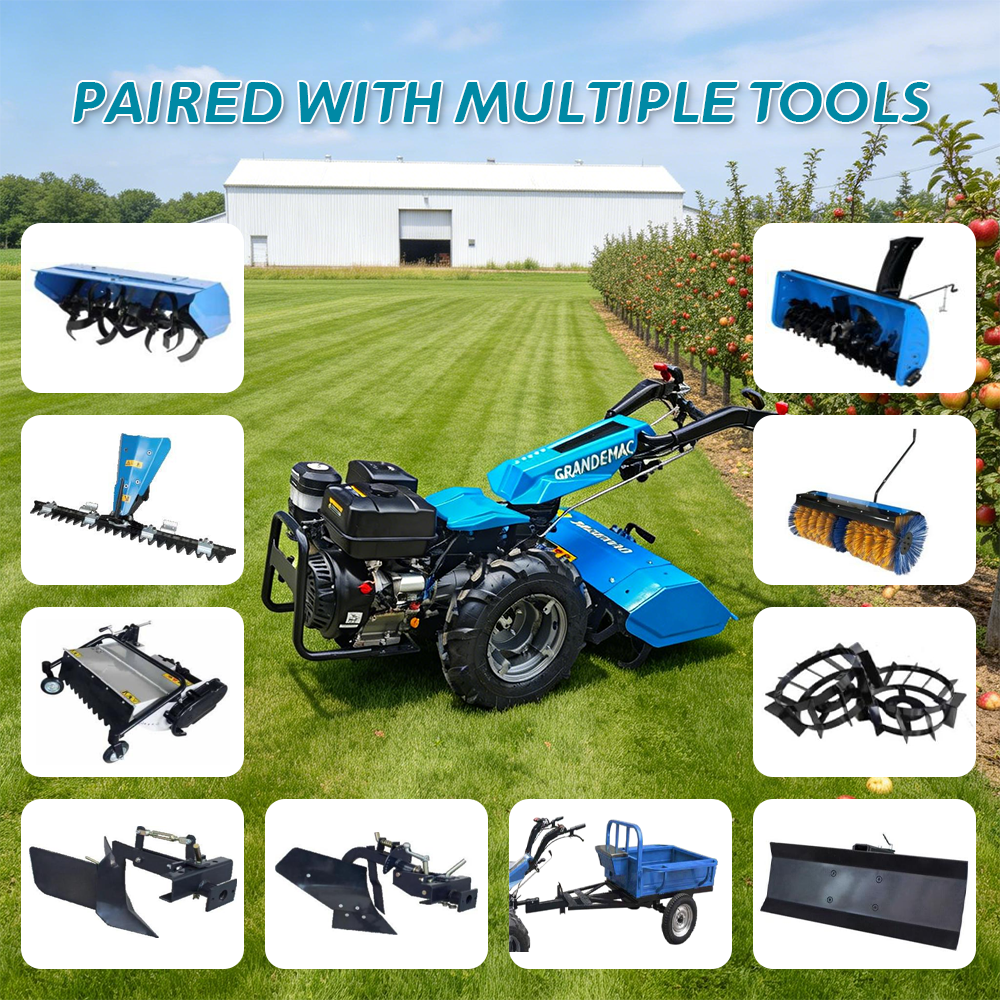
Operating walk-behind agricultural equipment transforms demanding soil and vegetation tasks into highly efficient processes. However, coupling these machines to heavy front- or rear-mounted implements inherently shifts their factory-calibrated center of gravity. This physical disruption creates an immediate problem for the operator in the field. Improper balance leads directly to rapid physical fatigue, causing you to constantly fight the handlebars. It also triggers severe traction loss known as wheel slip, while creating dangerous safety hazards on uneven terrain or steep slopes. To fix this, you need a precise mechanical strategy.
This article provides a technical, evidence-based framework for evaluating balance accessories and counterweights. You will learn how to adjust operator techniques to safely manage heavier implements under various conditions. Ultimately, we will show you how to maintain robust traction and lateral stability without sacrificing essential maneuverability in your work environments.
Key Takeaways
Center of Gravity (CoG) dictates control: Heavy implements require active counterbalance hardware to restore the factory-intended CoG and maintain tire-to-ground friction.
Hardware configuration is application-specific: Front bumper weights, wheel weights, and axle extensions serve distinct mechanical purposes and must be matched to the specific implement and terrain.
Terrain modifies load dynamics: Slopes and specialized environments (like orchards) require a wider wheelbase and lower gear selection to mitigate lateral rollover risks.
Operator mechanics matter: Relying on physical strength rather than machine balance is a primary indicator of improper setup and a precursor to injury.
Understanding Center of Gravity Dynamics in a Two Wheel Tractor
The Physics of Attachments
Cantilevered weight fundamentally alters machine physics. When you attach a heavy implement extending far past the PTO or the engine, it acts as a mechanical lever. A heavy rear-mounted rotary plow pulls down on the back. This lifting action raises the front engine. Conversely, a heavy front-mounted flail mower pulls the nose down. This lever effect forces the handles upward. You constantly fight this leverage if you ignore proper balance protocols. Operating an unbalanced Two Wheel Tractor demands excessive physical strength, leading quickly to severe operator fatigue.
Traction vs. Slip
Improper balance correlates directly to wheel slip. Traction relies entirely on tire-to-ground friction. Friction requires consistent downward pressure on the drive axle. When cantilevered weight lifts the machine off its drive axle, you lose this critical downward force. The tire treads lose their bite into the soil. At this point, traction fails completely. You then find yourself physically pushing or pulling the machine forward. Restoring the center of gravity pushes the axle back down, ensuring the tires grip the earth firmly.
Risk Assessment Framework
Before you engage the PTO, you must evaluate the setup. Introduce a standard pre-operation checklist to ensure mechanical safety. Follow this basic static assessment framework:
Park the machine on completely flat, stable ground.
Attach the implement securely and tighten all coupling bolts.
Conduct a static balance check by standing between the handles.
Lift the handles to a normal operating height.
Assess the pivot point. The machine should rest neutrally on its axle.
Gauge handle-lift resistance. You should feel less than ten pounds of upward or downward pressure.
Failing this assessment means you must adjust your hardware configuration before starting the engine.
Evaluating Hardware Solutions for Load Balancing
Bumper and Engine Weights
Heavy rear-mount soil-working implements require front-end counteraction. Rotary plows and heavy tillers push the rear down. You solve this by adding front bumper weights or engine weights. You calculate the required weight based on implement length and mass. Most heavy rear tools require 30 to 50 pounds of front counterbalance. Check your manufacturer limits carefully. You want to avoid overloading the front axle. Overloading causes front tire trenching and makes steering incredibly difficult.
Hardware Counterbalance Guideline Chart
Implement Type
Imbalance Direction
Counterweight Hardware
Estimated Weight Needed
Rotary Plow
Rear-heavy (lifts front)
Front Bumper Weights
30-50 lbs
Flail Mower
Front-heavy (lifts rear)
None (Use Gauge Wheels)
N/A
Power Harrow
Rear-heavy (moderate)
Engine Mount Weights
20-30 lbs
Heavy Snow Blower
Front-heavy (lifts handles)
Rear Handle Weights
15-25 lbs
Wheel Weights
Wheel weights lower the overall center of gravity. They increase tire bite without shifting weight forward or backward. You use them to enhance overall stability. However, implementation requires careful thought. Wheel weights add unsprung mass to the driveline. This extra mass anchors the machine firmly to the ground. While this prevents wheel slip, it can make tight pivoting more strenuous. You should ideally combine wheel weights and individual steering brakes. The brakes allow you to pivot the heavy mass easily.
Implement-Specific Skid Shoes and Gauge Wheels
You do not always need steel weights. Sometimes, the implement should support itself. Implement-specific skid shoes and gauge wheels carry the attachment load. They prevent weight transfer to the tractor handles. When you run a flail mower, set the front caster wheels properly. The caster wheels roll along the ground, bearing the mower deck mass. This frees up the axle to maintain traction. It also saves your arms from lifting the attachment throughout the workday.
Enhancing Lateral Stability for Slopes and Uneven Terrain
Axle Extensions and Track Width
Slopes demand maximum lateral stability. You achieve this by widening the machine stance. Expanding the track width by just a few inches increases lateral stability exponentially. You use axle extensions to push the wheels further outward. The math heavily favors a wider track. A wider base resists the overturning moment caused by gravity on a slope. If you run tall tires for ground clearance, you must use axle extensions. Tall tires raise the center of gravity, increasing rollover risk. Extensions negate this risk perfectly.
Dual Wheel Kits vs. Steel Wheels
Different terrains require different traction solutions. You must evaluate the trade-offs between dual wheels and steel cage wheels.
Dual Pneumatic Tires: These provide excellent flotation. They prevent the machine from sinking into soft, muddy ground. They also double the machine width, offering supreme stability on moderate hills.
Steel Cage Wheels: These offer aggressive anti-slip bite. You use them on steep, hard-packed gradients. They dig into firm soil, preventing the machine from sliding sideways down a hill.
Tire Pressure Considerations
Tire PSI dictates your ground contact patch. When you carry offset loads, proper pressure becomes vital. High tire pressure creates a rounded tire profile. This reduces the contact patch and encourages slip. Lower tire pressure flattens the tread against the dirt. A flatter tread maximizes friction. However, dropping the pressure too low risks unseating the tire bead from the rim. Check your tire pressure weekly. Keep it optimized for your specific implement load and soil softness.
Navigating Tight Clearances with an Orchard Two Wheel Tractor
The Orchard Use Case
Working in dense agricultural environments presents unique challenges. You must navigate beneath low canopies and steer between narrow tree rows. This often requires running heavy flail mowers on side slopes. The environment restricts your physical space. You cannot easily dodge or muscle a machine when branches surround you. The equipment must behave predictably. An Orchard Two Wheel Tractor demands precise balance because operator escape routes are limited. If the machine suddenly slips sideways, it can damage valuable crops or pin the operator against a trunk.
Balancing Maneuverability and Stability
You face a direct conflict in orchards. You need a narrow configuration for tight rows. Yet, you need a wide stance to prevent side-slipping on slopes. To balance this, you optimize the wheel setup. Choose the widest possible track width that still clears your narrowest row. Use low-profile tires to drop the center of gravity. Mount heavy implements as close to the PTO connection as possible. Shorter implements reduce the leverage effect. This keeps the machine narrow, low, and incredibly stable.
Differential and Steering Brake Utilization
You cannot wrestle a heavily weighted machine through a zero-turn maneuver. Instead, rely on mechanical features. Differential locks and steering brakes are mandatory for orchard navigation under heavy loads. Keep the differential locked for straight-line traction. When you reach the end of a row, unlock the differential. Squeeze the inner steering brake firmly. The machine will pivot around the braked wheel effortlessly. This technique lets you turn heavy, balanced equipment sharply without relying on brute force.
Implementation Realities: Safe Coupling and Operation Strategies
The Static Test
Never engage the PTO before testing machine balance. You must verify neutral handling first. Stand on flat ground and connect the implement. Lift the handles to your waist. Let go of the grips slightly, keeping your hands hovering closely. The handles should remain floating at operating height. They should require minimal upward or downward pressure to maintain this neutral position. If the handles slam to the ground, add front weight. If the handles jerk upward into your chest, add rear weight or adjust the gauge wheels.
PTO Engagement Protocols
Heavy implements generate massive rotational inertia. When they spool up, they create a torque-twist effect. Dumping the clutch violently sends a shockwave through the chassis. This twist can throw you off balance instantly. It can also snap shear pins or damage the transmission.
Lower the engine RPM to a fast idle before engaging.
Squeeze the clutch lever fully.
Engage the PTO lever securely.
Release the clutch lever incredibly smoothly.
Allow the implement to reach full speed gradually.
Increase engine throttle to the required operating RPM.
Handling Downhill vs. Uphill Loads
Slope work requires advanced technical adjustments. Always keep heavy implements on the uphill side whenever possible. If you mow across a slope, position the machine so the heavy deck rests uphill. This shifts the center of gravity into the hill, preventing rollovers. Furthermore, understand engine oil starvation angles. Four-stroke engines rely on splash lubrication. Operating on extreme angles moves oil away from the internal dipper. Read your engine manual to determine the maximum safe operating angle. Exceeding this angle seizes the engine, regardless of how well you balanced the chassis.
Conclusion
Proper balance relies entirely on applied physics and mechanical awareness, not brute physical force. Operating heavy implements safely means managing the center of gravity proactively. By understanding cantilever leverage, you can select the correct weights, wheel extensions, and tire pressures for your specific environment. A well-balanced machine preserves traction, protects the soil, and eliminates operator fatigue.
As a next step, audit your current implement setups carefully. Conduct a static balance test on flat ground before your next workday. Evaluate whether you need OEM counterweights, axle extensions, or steering brakes to resolve ongoing traction issues. Making these hardware adjustments guarantees a safer, more productive workflow in the field.
FAQ
Q: How do I know if my two wheel tractor needs front counterweights?
A: If you have to continuously pull up on the handlebars to keep the implement engaged with the soil, or if you experience wheel slip despite good tire tread, the rear load is too heavy and requires a front counterweight.
Q: Can axle extensions replace the need for wheel weights?
A: No. Axle extensions increase lateral stability by preventing side-to-side tipping. Wheel weights increase downward force for traction, preventing wheel slip. They solve two completely different physical problems in the field.
Q: Is it safe to operate heavy implements without steering brakes?
A: While possible on flat, open ground, operating heavily weighted or dual-wheel configurations without steering brakes significantly increases operator fatigue. It also makes precise turning in confined spaces very difficult.
Q: Does wheel size affect the balance of heavy attachments?
A: Yes. Larger wheels raise the center of gravity, which inherently decreases lateral stability. When using larger wheels for better ground clearance, widening the wheelbase is highly recommended to compensate for the higher center of gravity.