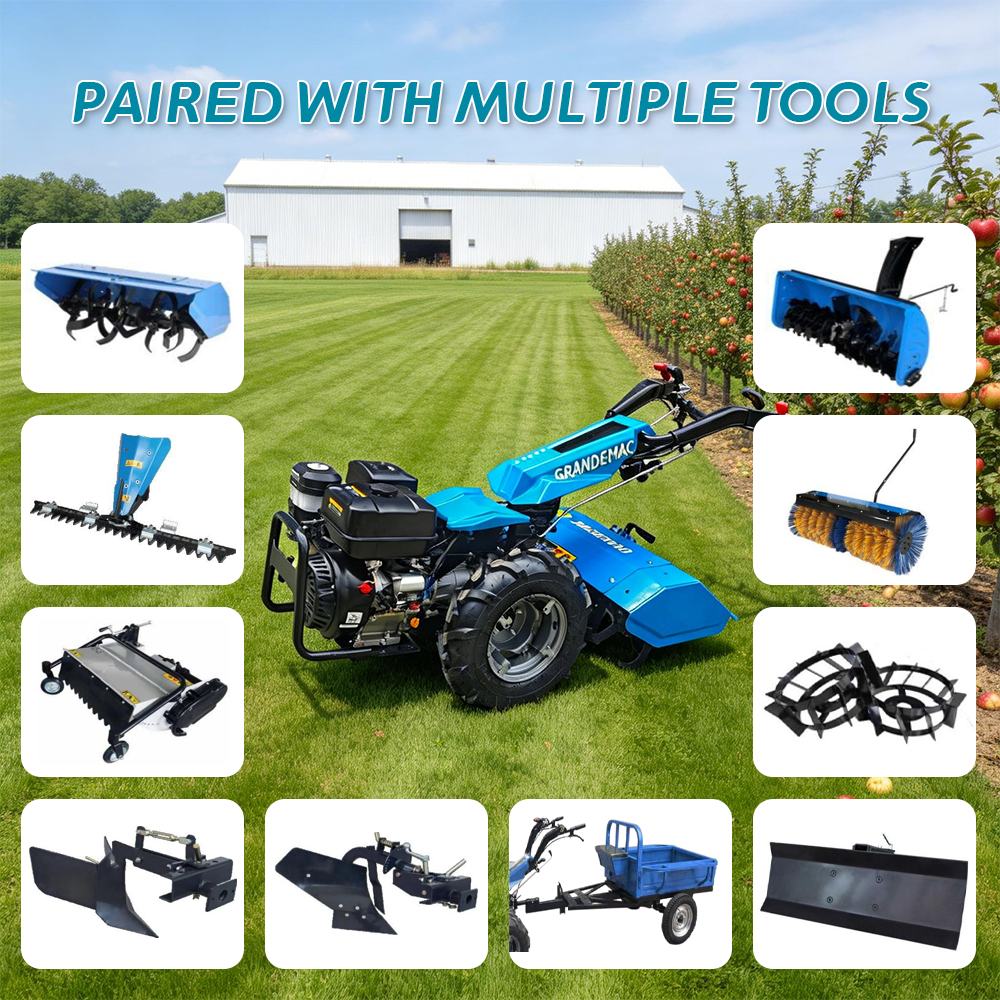
Moving materials across a farm often forces a difficult choice. You either break your back pushing manual wheelbarrows or drain your budget on heavy machinery. Transitioning to mechanized transport usually means absorbing a massive capital expense. Most operators assume they must buy a four-wheel compact tractor or a utility terrain vehicle (UTV). These large machines often sit idle for days. They also cause severe soil compaction in narrow rows.
Fortunately, pairing a soil-working machine with a utility trailer offers a highly efficient alternative. It transforms your cultivator into a high-traction transport vehicle. A Two Wheel Tractor easily hooks up to a transport cart. This turns a single-axle power unit into a dedicated hauling tool.
However, we must view this solution through a realistic lens. This setup thrives in high-density planting environments. Yet, it carries strict payload and speed limits compared to traditional vehicles. In this article, you will learn exactly how to configure these machines safely. We will explore coupling mechanics, payload capacities, and essential braking dynamics.
Key Takeaways
Cost-to-Utility Ratio: A trailer attachment allows a single power unit to handle both cultivation and logistics, maximizing equipment ROI.
Payload Realities: Most heavy-duty trailers for walk-behind tractors safely haul between 800 and 1,500 lbs, depending on terrain and tractor weight.
Tight-Space Maneuverability: Ideal for narrow agricultural setups; an orchard two wheel tractor with a trailer can navigate rows where traditional tractors cause severe soil compaction or simply cannot fit.
Safety Imperatives: Safe transport requires strict adherence to tongue-weight limits, matching wheel speed to walking/riding gears, and utilizing independent trailer brakes on inclines.
The Business Case: Two Wheel Tractors vs. UTVs and Compact Tractors
Farm logistics demand reliable equipment. Choosing the right machinery impacts your daily operations significantly. We must analyze how a single-axle setup compares to larger alternatives.
Operational Cost Analysis
Maintaining multiple engines drains resources rapidly. A dedicated UTV requires its own oil changes, filters, and spark plugs. It demands separate storage space. A compact tractor carries similar maintenance burdens. Conversely, a walk-behind unit consolidates your engine maintenance. You maintain one power unit. You use it for tilling, mowing, and hauling. Swapping implements takes minutes. This consolidation reduces your annual maintenance footprint. You avoid buying a separate transport vehicle. The initial capital required for a trailer is a fraction of a new UTV.
Soil Compaction & Agility
Heavy machinery ruins delicate soil structures. A standard compact tractor weighs over 2,000 lbs before loading cargo. This high gross vehicle weight (GVW) creates deep ruts. It compacts the root zones in your fields. Walk-behind setups offer a massive footprint advantage. They weigh significantly less. They distribute weight evenly across large tires. This lower GVW protects soil biology during harvest transport. Furthermore, they offer unmatched agility. A single-axle machine pivots on a dime. You can weave through tight gates easily.
Success Criteria
This transport method is not a universal solution. It works brilliantly in specific scenarios. It fails completely in others. You must understand these boundaries.
When it succeeds: Properties under 10 acres benefit immensely. Narrow row widths demand this exact agility. Farms utilizing multi-use equipment strategies find great success here.
When it fails: Highway transport remains strictly off-limits. High-speed hauling over long distances will damage the machine. It also endangers the operator. Large acreage farms require faster, heavier vehicles.
Common Mistake: Operators often try to replace a full-sized pickup truck with a walk-behind trailer. You must respect the machine's intended agricultural scale.
Technical Evaluation: Mechanics of Tractor-Trailer Coupling
Connecting a trailer to a walk-behind unit involves specific engineering. The connection must handle heavy pulling forces. It must also traverse uneven ground safely.
Hitch Types and Articulation
The trailer couples directly to the power take-off (PTO) housing or a heavy-duty drawbar. This connection is not a simple pin drop. True agricultural trailers use specialized curved couplers. These adapters feature multiple pivot points. They allow the trailer to articulate independently. If the tractor tilts left over a rock, the trailer can remain flat. This independent articulation prevents rollover accidents. It keeps the PTO shaft free from binding under load.
Powered vs. Unpowered Trailers
Operators must choose between two primary drive systems. Your terrain dictates this choice entirely.
Unpowered (Free-rolling): These trailers rely entirely on the tractor for traction. They feature free-spinning axles. They work best for flat terrain. They handle lighter loads perfectly. They cost much less to purchase and maintain.
Powered (Driven axle): These trailers synchronize with the tractor's PTO. The PTO physically turns the trailer wheels. This creates true 4x4 traction. You need this setup for steep, muddy hills. The higher cost is justified when your terrain causes standard wheels to slip constantly.
Table 1: Powered vs. Unpowered Trailer Comparison
Feature
Unpowered Trailer
Powered (Driven) Trailer
Traction Source
Tractor wheels only (2WD)
Tractor + Trailer wheels (4WD)
Terrain Suitability
Flat ground, dry conditions
Steep inclines, deep mud
Mechanical Complexity
Low (No driveshaft)
High (PTO synchronization)
Payload Capability
Moderate (800 - 1,000 lbs)
Maximum (Up to 1,500 lbs)
Operator Seating
Moving cargo all day requires ergonomic consideration. Basic transport carts force you to walk behind them. You steer the handles while walking. This tires you out over long distances. Ride-on sulky trailers solve this problem. They include a dedicated operator seat above the hitch. You ride along with the cargo. This reduces fatigue significantly. However, riding changes your center of gravity. You must steer with smooth, deliberate movements to maintain balance.
Payload Capacity and Terrain Capabilities
Understanding weight dynamics ensures safe transport. Overloading a machine guarantees failure. You must match your cargo to your engine size.
Weight Limits by Tractor Class
Baseline capacities depend entirely on the power unit. A lightweight 8hp engine lacks the torque for maximum payloads. It also lacks the physical mass to stop a heavy trailer. You can safely tow around 800 lbs with an 8hp gas unit. Conversely, a 15hp diesel engine offers massive low-end torque. The heavier diesel block anchors the machine better. These heavy-duty units can pull up to 1,500 lbs safely. Always verify the manufacturer's towing rating before loading harvest crates.
Navigating Specific Environments
Certain agricultural setups pose unique logistical hurdles. High-density plantings leave very little room for equipment. This is where an Orchard Two Wheel Tractor paired with a narrow trailer shines. Orchards feature low-hanging branches. Vineyards utilize tightly spaced trellises. Traditional tractors rip branches down. They crush shallow root systems. A single-axle orchard machine slips right under the canopy. It navigates these dense rows without damaging your high-value crops. You can pull harvest bins directly from the deepest parts of the field.
Traction Physics
Pulling heavy loads requires proper weight distribution. Tongue weight dictates your pulling power. The tongue is the connection point between trailer and tractor. You must load your cargo strategically. If you place all weight at the rear of the trailer, the tongue lifts up. This removes weight from the tractor's drive wheels. The tires will simply spin in the dirt. If you place too much weight at the front, steering becomes impossibly heavy.
Follow these rules of thumb for trailer loading:
Place roughly 60% of the cargo weight ahead of the trailer axle.
Ensure the tongue applies steady downward pressure on the hitch.
Never exceed a tongue weight that lifts the operator off their feet.
Test traction on flat ground before tackling a hill.
Implementation Risks: Wheel Speed, Braking, and Safety Standards
Mechanized transport introduces physical risks. Moving a heavy mass requires strict safety protocols. Ignoring these rules leads to severe accidents.
Wheel Speed Limitations
Many users misunderstand transport speeds. Walk-behind machines utilize designated gear reductions. They prioritize torque over speed. Most units max out at 6 to 9 mph in their highest transport gear. This feels slow compared to a truck. It is entirely intentional. Do not attempt to modify transport wheel speeds. Changing pulley ratios or installing oversized tires degrades stability. The machine lacks the suspension to handle speeds above 10 mph. High-speed hauling will cause violent bouncing and loss of control.
Braking Dynamics
Going up a hill requires engine power. Going down a hill requires massive braking force. The necessity of trailer brakes cannot be overstated. An unbraked trailer pushes the tractor downhill. This causes "jackknifing". The trailer swings sideways and flips the machine. Heavily loaded trailers must feature an independent braking system. This usually involves a mechanical foot pedal on the sulky. You apply the trailer brakes first. This keeps the rig stretched out tight. It prevents the cargo from overrunning the power unit.
Steering with Differential Locks
Steering a loaded trailer requires specific techniques. Most heavy-duty power units feature a differential lock. This lock forces both wheels to spin together for straight-line traction. You cannot easily turn a loaded trailer with the differential locked. The machine will want to plow straight ahead.
Best Practice for Steering:
Disengage the differential lock before entering a tight turn.
Use independent steering brakes if your machine has them. Apply the left brake to pivot left.
Maintain steady forward momentum. Stopping mid-turn makes resuming travel very difficult.
Re-engage the differential lock once you are facing straight again.
Buyer’s Checklist: Shortlisting the Right Trailer for Your Operation
Buying the correct trailer requires careful planning. You must match the trailer's features to your daily cargo.
Bed Dimensions & Material
Trailer beds endure constant abuse. You must select the right material. Galvanized steel beds resist rust well. They handle rigid harvest crates and sharp firewood easily. However, they are heavy. Poly dump beds offer a lightweight alternative. High-density polyethylene flexes upon impact. It will not dent. Poly beds also shed wet compost and sticky soil much faster than steel. Match the bed type to your primary cargo.
Dump Mechanisms
Unloading heavy materials quickly saves labor. Evaluate the dump mechanism carefully.
Manual Release (Gravity Tip): You pull a lever. The bed tips backward using gravity. You must physically push the bed back down. It is cheap and highly reliable.
Hydraulic Dump: A hydraulic cylinder lifts the bed. It operates via the tractor's PTO or a separate battery. It dumps effortlessly. However, it requires hydraulic fluid checks. It also introduces potential hose leaks. Note these maintenance trade-offs before buying.
Tire Specifications
Tire selection impacts your field conditions. Standard agricultural lugs feature deep V-shaped treads. They dig into the soil for traction. This is great for tractors but bad for unpowered trailers. Dragging lug tires creates deep ruts. We recommend flotation tires for the trailer axle. Flotation tires are wide and smooth. They spread the load over a larger surface area. They roll easily over wet grass. They minimize rutting in damp transport conditions.
Next-Step Actions
Before contacting a dealer, complete a quick inventory. Determine your heaviest typical load in pounds. Measure the narrowest gate or row on your property. Identify the steepest grade you must traverse. Present these three facts to a dealer. They will match your tractor horsepower to the correct trailer size seamlessly.
Conclusion
Pairing a single-axle power unit with a utility trailer offers immense strategic value. It provides a modular, scalable approach to farm and homestead logistics. You avoid the massive expense of a dedicated UTV. You also protect your soil from heavy vehicle compaction.
However, you must remember the core constraints. Success depends entirely on respecting the physics of payload distribution. You must adhere to the 6-9 mph operating speed limits. You must utilize independent braking on hills.
Take action today. Evaluate your row widths and calculate your maximum payload requirements. Consult with an equipment specialist to configure your hitch and braking systems correctly. This careful planning ensures a safe, highly productive transport setup for years to come.
FAQ
Q: Can I drive a two-wheel tractor and trailer on public roads?
A: Generally no. They lack required lighting, DOT-approved tires, and minimum speed capabilities for safe public road transport. Strictly for off-road/agricultural use.
Q: How steep of a hill can a two wheel tractor pull a loaded trailer up?
A: Dependent on traction, trailer type, and weight. Highlight that going down the hill is usually the limiting safety factor due to braking requirements. Always test slopes empty before hauling cargo.
Q: Do I need a special hitch to attach a utility trailer to my walk-behind tractor?
A: Yes, proprietary curved couplers or heavy-duty drawbar adapters are required to allow vertical and horizontal articulation without binding the PTO. Never use a standard rigid automotive hitch.