Mowing uneven terrain or steep gradients introduces distinct mechanical stress. Standard flat-lawn equipment simply cannot handle these extreme demands. Safety risks multiply rapidly when you push standard machinery beyond its intended limits. Evaluating whether a standard lawn tractor is sufficient for your property requires deeper mechanical understanding. You must analyze the machine's center of gravity and its physical traction capabilities. Ignoring these crucial factors often leads to dangerous rollovers and costly equipment failures.
This article provides a clear technical framework for assessing slope performance. You will learn the exact safety thresholds you must strictly observe. We will also help you determine exactly when a heavy-duty terrain upgrade becomes mandatory. By understanding the underlying physics, you can protect both your machinery and yourself.
Key Takeaways
Standard lawn tractors are generally engineered for maximum slopes of 15 degrees; pushing beyond this risks transaxle failure and rollover.
A lawn tractor handles uneven ground via pivoting front axles and anti-scalp deck wheels, but traction is heavily dependent on tire tread and weight distribution.
For gradients approaching 30 to 45 degrees, or heavily rutted agricultural land, standard consumer tractors fail; heavier alternatives like a 40HP Orchard Tractor or specialized slope mowers become necessary.
Safe operation requires strict adherence to vertical mowing patterns (up and down) rather than parallel hillside passes.
The Mechanics: How a Lawn Tractor Navigates Uneven Terrain
Pivoting Front Axle (Cast Iron vs. Steel)
A tractor relies heavily on its front axle design. The front axle articulates independently from the main chassis frame. This pivoting motion allows the machine to traverse dips and ruts. It keeps all four wheels firmly planted on the ground. Maintaining ground contact ensures you retain full steering control. Manufacturers offer these axles in stamped steel or solid cast iron. Steel axles keep production costs low but easily bend under heavy impacts. Cast iron axles provide superior durability for rough terrain. They also add vital unsprung weight to the front end. Extra front weight significantly reduces the likelihood of an unexpected backflip.
Center of Gravity Dynamics
Stability on a slope depends entirely on the center of gravity. Most consumer mowers feature front-mounted engines. This placement shifts the primary mass forward. However, operator weight also plays a massive role in stability. You sit relatively high on the machine. This elevated seating position naturally raises the overall center of gravity. When traversing an incline, gravity constantly pulls the highest heavy point downward. A higher center of gravity makes the machine highly prone to tipping. You must calculate how operator weight shifts when cresting hills or entering deep ditches.
Transaxle and Hydrostatic Drive Limits
Climbing hills forces the transmission to work exceptionally hard. Entry-level mowers typically utilize light-duty hydrostatic drives. These systems pump hydraulic fluid to generate forward motion. Pushing excessive weight up a hill causes immense internal fluid pressure. Cheap transaxles cannot handle this sustained load safely. Fluid bypass occurs inside the hydrostatic transmission. The oil overheats quickly and loses its necessary viscosity. You will experience a sudden loss of drive power. Prolonged slope work essentially destroys entry-level hydrostatic units over time.
Deck Flotation (Anti-Scalp Wheels)
Navigating rough ground introduces the risk of scalping the grass. The mower deck hangs suspended beneath the main tractor frame. Mowing across a terraced crown forces the blades downward. Gauge wheels mount directly to the outer edges of the mower deck. These specialized anti-scalp wheels prevent the metal housing from digging into the soil. They gently lift the deck over minor obstacles. Properly adjusted gauge wheels float slightly above flat ground. They only engage the terrain when rolling over an uneven crest or a sudden dip.
Establishing the Gradient Baseline: What is a "Safe" Slope?
The 15-Degree Manufacturer Standard
Equipment manuals strictly dictate safe operating angles. Almost all consumer manuals cap safe operation at 15 degrees. This angle roughly equals a 26 percent grade. Engineers establish this precise limit based on mathematical rollover probabilities. The engine lubrication system also relies on this 15-degree limit. Tipping an engine too far deprives the oil pump of vital fluid. This oil starvation destroys internal engine bearings rapidly. Exceeding the 15-degree threshold instantly voids your warranty. It also places the operator in immediate physical danger.
The 30-45 Degree Reality Check
Many property owners battle extreme slopes or terraced retaining walls. A 30-degree or 45-degree slope presents an impassable obstacle for standard mowers. Standard tires cannot generate sufficient grip on steep inclines. A consumer mower will break traction and slide unpredictably. Sliding sideways on a 30-degree hill guarantees a fatal side-rollover. The machine's center of gravity shifts past the downhill tires. Physics takes over completely at this critical threshold. Standard residential equipment has zero capacity for these extreme environments.
Traction vs. Gravity
Gravity constantly fights against your tires during a climb. Tire slippage depends heavily on surface conditions and moisture levels. Wet grass acts like an ice rink for rubber tires. Dry grass offers substantially better frictional resistance. Climbing uphill transfers machine weight to the rear axle. This increases rear grip but severely lightens the front steering tires. Descending a hill reverses this entire dynamic. The rear tires lose their gripping authority during a steep descent. You lose steering control entirely if the rear wheels begin sliding forward.
Slope Capability and Risk Framework
Slope Angle
Equivalent Grade (%)
Equipment Suitability
Primary Risk Factor
0 - 10 Degrees
0 - 17%
Standard Consumer Mower
Minimal; standard operation applies.
11 - 15 Degrees
18 - 26%
Heavy-Duty Garden Mower
Transmission overheating, slight slip.
16 - 25 Degrees
27 - 46%
Dedicated Slope Mower
Loss of steering, oil starvation.
26 - 45 Degrees
47 - 100%
4WD Utility / Sub-Compact
Fatal rollover, complete traction loss.
Lawn Tractor vs. Zero-Turn vs. Heavy-Duty Alternatives
Lawn Tractor (Steering Wheel)
Standard mowers utilize a traditional front-wheel steering system. This design pushes the engine weight directly over the front axle. Better frontal weight distribution keeps the steering tires planted securely. It makes them superior for holding a straight line on moderate hills. The mechanical steering linkage forces the wheels to turn regardless of traction. This provides predictable handling across rolling properties. Operators feel more secure sitting behind a fixed steering wheel on an incline.
Zero-Turn Mowers (Caster Wheels)
Zero-turn machines dominate flat ground due to incredible speed. However, they struggle dangerously on uneven, hilly terrain. The front caster wheels spin freely without any mechanical steering control. The machine relies entirely on rear-wheel differential braking to change direction. Turning requires slowing one rear wheel while accelerating the other. This braking action easily breaks traction on wet grass. Zero-turns prone to violent downhill slides when traction fails. They lack the front-end authority required to arrest a sudden slide.
The Heavy-Duty Upgrade (40HP Orchard Tractor / Sub-Compact)
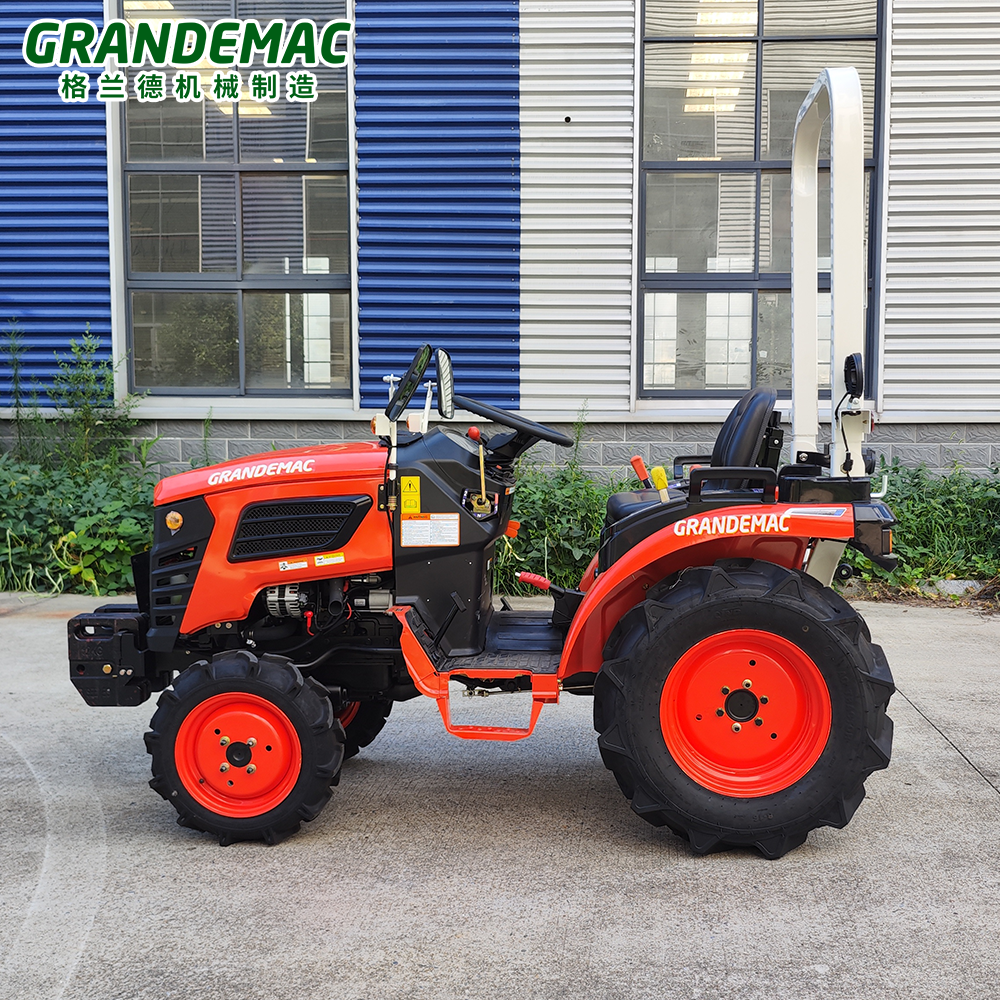
Acreage, deep ruts, and severe slope severity often exceed consumer limits. Professional terrain requires professional agricultural equipment. This is where a heavy-duty 40HP Orchard Tractor becomes an absolute necessity. These machines provide selectable four-wheel drive for ultimate grip. Locking differentials force both wheels to turn simultaneously through mud. High-torque diesel engines easily carry heavy implements up steep inclines. Most importantly, they feature mandatory ROPS (Roll-Over Protective Structures). A ROPS frame saves lives during unpredictable sideways rollovers on severe terrain.
Core Evaluation Criteria: Specifying a Tractor for Hilly Properties
Transmission Grade
You must evaluate the transaxle rating before purchasing equipment for hills. Light-duty lawn-mowing transaxles handle flat turf and gentle slopes perfectly. They fail miserably when subjected to heavy climbing loads. You need a ground-engaging rated transmission for hilly properties. These heavy-duty units feature larger internal pumps and robust cooling fans. Better cooling prevents the hydraulic fluid from breaking down under stress. Ground-engaging transmissions deliver continuous torque without internal slippage or burnout.
Locking Rear Differential
Standard axles send power to the wheel with the least resistance. Slipping on wet grass causes one wheel to spin uselessly. The opposite wheel receives absolutely zero engine power. A locking rear differential solves this major operational problem. Engaging the differential lock mechanically binds the two rear axles together. It forces both tires to rotate at the exact same speed. This crucial feature pulls the machine out of deep dips and muddy ruts easily.
Tire Selection (Turf vs. Lug/Ag Tires)
Tire tread patterns dictate how well the machine grips the earth. You must carefully balance hill traction against potential turf damage.
Turf Tires: Feature shallow, tightly packed tread blocks. They protect manicured grass from tearing during tight turns. Turf tires offer minimal grip on steep or wet inclines.
All-Terrain (AT) Tires: Provide a balanced hybrid tread pattern. They offer moderate hill traction without destroying the lawn completely.
Agricultural (Ag/Lug) Tires: Feature deep, aggressive, widely spaced chevron bars. They bite aggressively into soft dirt and steep hills. Ag tires will heavily scar delicate turf during sharp maneuvers.
Wheelbase and Track Width
A machine's physical footprint determines its mathematical rollover threshold. Track width represents the distance between the left and right tires. Wheelbase measures the distance between the front and rear axles. A wider stance drastically reduces the probability of a side-rollover. It pushes the tipping point further away from the machine's center line. A longer wheelbase prevents unexpected backflips when climbing steep grades. Sub-compact machines utilize a broad stance to maximize stability on treacherous ground.
Implementation: Operational Safety Protocols on Slopes
The Directional Rule
Safe hillside operation requires strict directional discipline. You must mow straight up and straight down the slope. You should never drive horizontally across the face of a steep hill. Driving sideways exposes the machine to an immediate side-rollover risk. The center of gravity shifts dangerously toward the downhill wheels. A hidden hole on the downhill side instantly drops the tire and flips the machine. Moving vertically keeps the weight distributed evenly between the left and right sides.
Speed and Braking Adjustments
Momentum acts as your worst enemy on steep declines. You must establish a slow, controlled speed before beginning your descent. Never attempt to freewheel or coast down a hill. Sudden braking causes the rear tires to lock up and skid uncontrollably. You should utilize dynamic braking via the hydrostatic transmission instead. Easing off the forward drive pedal naturally restricts hydraulic flow. This internal restriction securely slows the machine without breaking tire traction.
Attachment Considerations
Towing accessories completely alters the machine's operational physics. Carts, sprayers, and rear baggers add massive amounts of external weight.
Empty Carts First: Always test steep slopes with an empty cart to gauge traction.
Account for Liquid Weight: Sprayer tanks slosh liquid backward during climbs, drastically shifting the balance point.
Counterbalance Baggers: Heavy rear grass baggers require heavy front bumper weights to keep the steering tires planted.
Reduce Safe Angles: Reduce the manufacturer's maximum safe slope limit by at least 50% when towing any implement.
Conclusion
A high-quality consumer mower handles uneven, rolling ground and gentle slopes quite well. Excellent performance requires a robust transmission, cast-iron axles, and appropriate tire selection. However, physics ultimately dictates the absolute limits of standard residential equipment. Pushing beyond the established 15-degree threshold invites severe mechanical damage and physical danger.
You must actively measure your property's steepest gradients using a clinometer app or a smart level. Analyze the depth of your terrain ruts and the frequency of your steep inclines. If your property features gradients exceeding 15 degrees, you must abandon consumer mowers. Upgrade to a dedicated slope mower or a heavy-duty agricultural machine immediately. Prioritize safety by investing in equipment featuring four-wheel drive, locking differentials, and protective rollover structures.
FAQ
Q: Can a standard lawn tractor handle a 30-degree slope?
A: No. Operating standard residential equipment on a 30-degree slope violates all manufacturer safety limits. It carries a severe, immediate risk of fatal rollover and complete transmission failure. Standard tires cannot grip grades this steep safely.
Q: Is a zero-turn or a lawn tractor better for uneven, hilly ground?
A: A standard tractor is generally safer on hills due to front-wheel steering and better forward weight distribution. Zero-turns rely on caster wheels and easily lose traction, causing them to slide uncontrollably on wet slopes. Commercial zero-turns with specialized slope track designs are the only exception.
Q: How do I prevent my lawn tractor mower deck from scalping uneven ground?
A: Ensure the deck's anti-scalp gauge wheels are properly adjusted. They should sit about 1/4 to 1/2 inch off the ground when parked on a flat surface. They should only engage when the machine rolls over a crest or a sharp dip.
Q: Do I need wheel weights for mowing on hills?
A: Rear wheel weights or liquid-filled tires successfully lower the center of gravity. They heavily improve uphill traction. However, they do not mathematically increase the safe maximum slope rating established by the manufacturer.